
Scientists and spine surgeons from the University of New South Wales (UNSW) in Australia have invented a new spinal fusion device that stabilizes the spine, reduces chronic back pain and promotes fusion without screws or rods.
New Screw-Less, Rod-Less Spine Fusion Device From Australia
2 min read Premium comments
Secondary
Called the Thru-Fuze device, its inventors hope that it can someday replace more invasive and expensive methods of treating degenerative disc disease (DDD) surgically. The current standard of surgical intervention for DDD requires a system of screws, rods or cage systems as well as drilling into the spine and a bone graft harvest.
Professor Bill Walsh, one of the inventors of Thru-Fuze and Director of Surgical and Orthopaedic Laboratories at the University of New South Wales, said that the device will allow faster, simpler surgery with minimal radiation exposure compared to current methods.
“Existing methods of spinal fusion use rod or cage systems that require screws to be drilled into the spine and a painful bone graft harvested, which is the material used to form the bridge and obtain the fusion between the vertebrae in the spine, ” he said. “These systems are very costly, difficult and time consuming to implant and they also have variable rates of fusion success. Existing methods rely on the bone to make its way right across the vertebrae and it can take up to a year to find out if the surgery has been a success.”
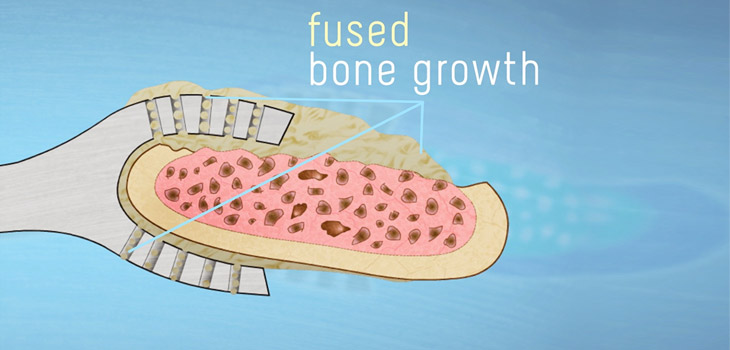
The Thru-Fuze device is innovative because it stabilizes the spine without the need for a bone graft.
UNSW surgeons hope that the Thru-Fuze device, following human clinical studies and regulatory approvals, will transform spinal fusion surgery for the treatment of degenerative disc disease.
Walsh’s team has shown that bone will fuse on and through their invention when it is placed between vertebrae, resulting in rapid ‘biomechanical’ fixation. “Over time, the device then acts as a bridge between the adjacent vertebrae for additional bone to grow across, fusing the adjacent vertebrae together, bone to bone, ” Walsh said.
Human trials are expected to begin at the Prince of Wales Hospital, Sydney in late 2016. They have been made possible through $1.59 million in funding from the NSW Government’s Medical Device Fund. Patents for the technology have been filed in Australia, Europe, China and the United States.
Author
React:
Discussion
This is a fascinating development. In my practice we've seen similar outcomes with the revised protocol. The key differentiator seems to be patient selection criteria. Has anyone else noticed the correlation with BMI thresholds?
Great point. I'd push back slightly on the conclusion, the sample size in the cited study is too small to draw population-level inferences. That said, the directional signal is compelling and worth a larger RCT.
We implemented a similar approach last year. Early results are promising but we're still gathering 12-month follow-up data. Happy to share our protocol if anyone is interested.
Join the conversation
Orthopedic professionals are discussing this. Sign in and upgrade to read every comment and add your voice.