
Hiroshima University and Daiya Industry Co. Ltd. in Japan have joined forces to revolutionize human movement. They have developed a wearable model of a device using pneumatic muscle. Called the Unplugged Powered Suit (UPS), the device supports human movement without requiring any electronic devices and tanks because it uses the new Pneumatic Gel Muscle (PGM) as an actuator.
New Endoskeleton Suit Aids Human Motion
2 min read Premium comments
Secondary
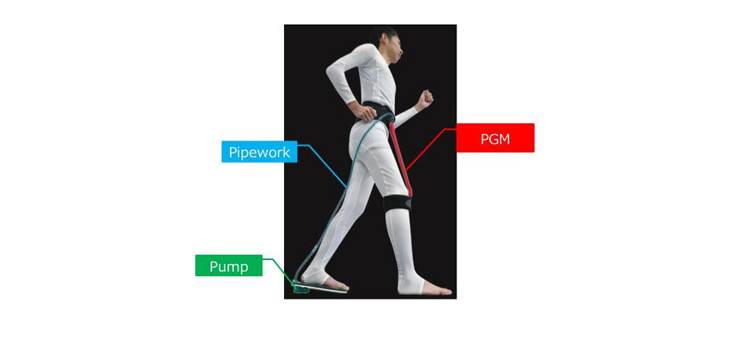
According to the November 22, 2015 news release, “the UPS consists of three parts: PGM (drive part), pump (air pressure for flexing artificial muscle), and pipework (transmission). PGM is characterized as light and flexible, and can exert supportive power by low air pressure. The pump is equipped in the sole, and thus the driving force can be transmitted to PGM by using the human body weight. Overall, the UPS has a very simple structure, is easy to maintain, and is inexpensive.”
“For example, PGM covers the articulatio coxae and the pump is equipped on the contralateral sole. This arrangement makes it possible to support human hip movement in the swing phase, ” said Associate Professor Yuichi Kurita, Ph.D. at Hiroshima University.
“There are two examples of UPS application. One is to decrease muscle activity during jogging, and the other is to increase the pitch speed. To decrease muscle activation during jogging, PGM in the UPS is equipped along the musculus soleus and the pump is equipped on the ipsilateral toe. To increase the pitch speed, PGM in the UPS is equipped along the greater pectoral muscle and the pump is equipped on the contralateral toe.”
Yoshie Miura, research administrator for the project, told OTW, “To prevent injury and accidents by aging and muscle fatigue, it is important to provide patients with safe and easy-to-use assist devices. In traditional assistive equipment, compressors and tanks are necessary to exert sufficient power for supporting human motion. It is also expensive to maintain an assist device. We would like to develop an inexpensive one.”
“Our UPS has newly developed pneumatic artificial muscle provided by Daiya Industry Co. Ltd., Japan. This newly developed pneumatic artificial muscle can exert supportive power by low air pressure. It makes it possible to support human movement without compressors and tanks.”
“The traditional exoskeleton suit can exert high supportive power, but its usage situation is limited because of its heavy devices. Our UPS is an endoskeleton suit and our newly developed pneumatic artificial muscle is like human muscles (safe and low-cost.). We can customize the UPS to the user’s particular needs such as muscle strength for athletes and rehabilitation.”
Author
React:
Discussion
This is a fascinating development. In my practice we've seen similar outcomes with the revised protocol. The key differentiator seems to be patient selection criteria. Has anyone else noticed the correlation with BMI thresholds?
Great point. I'd push back slightly on the conclusion, the sample size in the cited study is too small to draw population-level inferences. That said, the directional signal is compelling and worth a larger RCT.
We implemented a similar approach last year. Early results are promising but we're still gathering 12-month follow-up data. Happy to share our protocol if anyone is interested.
Join the conversation
Orthopedic professionals are discussing this. Sign in and upgrade to read every comment and add your voice.