
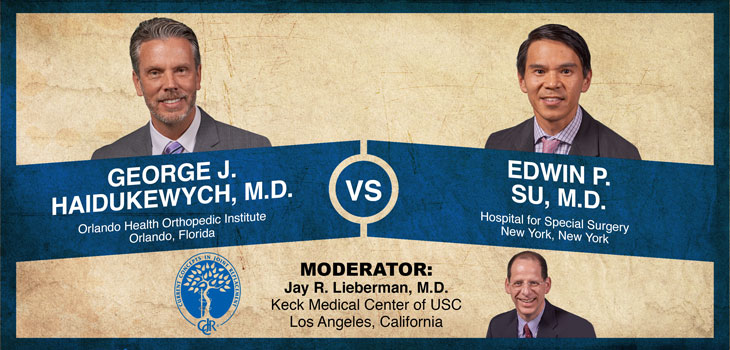
This week’s Orthopaedic Crossfire® debate was part of the 16th Annual Current Concepts in Joint Replacement® (CCJR) – Spring meeting, which took place in Las Vegas this past May. This week’s topic is “ORIF for Displaced Femoral Neck Fx’s in the <60 Active Patient.” For the proposition is George J. Haidukewych, M.D. Orlando Health Orthopedic Institute, Orlando, Florida. Edwin P. Su, M.D. Hospital for Special Surgery, New York, New York, is opposing. Moderating is Jay R. Lieberman, M.D., Keck Medical Center of USC, Los Angeles, California.
Haidukewych v Su: ORIF for Displaced Femoral Neck Fx’s in the <60 Active Patient
10 min read Premium comments
Great Debates
Dr. Haidukewych: The number of femoral neck fractures continues to increase. These are clearly life changing injuries. The purpose of my lecture is to discuss why young, active patients under 60 should keep their own femoral heads, if possible. I’m going to give you some specific tips and tricks to obtain an anatomic reduction and stable internal fixation that helps you reach that goal.
I will concede to Ed, that for patients over age 60 with a displaced femoral neck, arthroplasty is clearly the best treatment choice. The failure rate of ORIF [open reduction, internal fixation] in this setting remains over 40% and this is unchanged for the last 70 years. There are prospective Level One studies that show clear superiority of total hip arthroplasty over ORIF in the elderly patient and it is even more cost effective than ORIF.
However, in a young patient the best femoral head is their own. Why is it good to keep your own hyaline cartilage and hip? Well, you have no activity restrictions. You don’t dislocate, you don’t develop osteolysis, you don’t need cobalt chrome levels and MARS MRIs, you don’t develop infections, and, if you need salvage, you’re young and healthy. You could easily tolerate a salvage through total hip arthroplasty.
I just told you that in the elderly patient, the rate of reoperation is well over 40%. What is the rate of reoperation in a young patient, under 60, if they have ORIF? Well, the world literature says it’s somewhere between 15 and 25%. This is about half what we see in the older patient. So the take-home point for you is that one in five young patients will need conversion to total hip. The other four out of five, if you do a good job, will keep their own native femoral head and I think that’s worth it. Eight-five percent will keep their hips for 10 years, even though 24% get AVN [avascular necrosis] the survivorship of native femoral head is still quite good.
The results of ORIF, however, are strongly dependent on the quality of reduction and the implant choice, and somewhat dependent on timing and capsulotomy. Fixation should be done effectively and expeditiously. You need to get an accurate reduction and, in my opinion, you should choose a fixation device based on fracture verticality. Non-displaced fractures are relatively simple to treat. Three screws placed nicely spaced around the femoral neck to get good peripheral and calcar support will tolerate compression.
Now cortical support is important, even in young patients, to avoid displacement. But what about displaced fractures? I have some specific tips and tricks. To obtain anatomic reduction, optimal implant placement is important because in our series we found that if we did a good job and we got an anatomic reduction the AVN and non-union rates were low. If we had a fair to poor reduction, almost all of those patients went on to arthroplasty.
Look at the Pauwels’ grade to determine your implant fixation strategy. As the fracture angle increases from 30 to 70 degrees, the shear forces on your construct are going to increase and you need to somehow neutralize the tendency of the femoral head to shift inferiorly and medially.
Pauwels’ Type 1 fractures tolerate load very well. They can tolerate compression and simple screw placement is appropriate.
Pauwels’ Type 2 and 3, where you’re going to have a higher shear angle and more forces across the fracture, I would choose a fixed angle device with a de-rotation screw. There is data from several series that if do have a Pauwels’ Type 3 the failure rate with screws alone was twice as high as our series utilizing fixed angle devices. And in Gardner’s series the failure rate with screws alone was 7x higher than if they used a sliding hip screw.
Are there other implant options to neutralize the shear forces? Well, there have been a few other ideas proposed. Some authors have proposed the so-called cross-screw technique, or a Pauwel screw which is perpendicular to the fracture line. We looked this up and our failure rate was about 50%. I don’t think screws alone can neutralize the forces across the hip with a vertically placed fracture, and we have abandoned this idea completely.
Nails have been reported, believe it or not, as a way to neutralize forces, essentially as a way to connect the fixation of the head and neck to the shaft. Definitely better than screws alone. I think there are some technical challenges to make sure that the reduction stays put while you’re placing the fixation device. But it is an alternative that has been reported in some series.
So in my opinion, a young, active patient under age 60 should keep his or her own femoral head and ORIF is the best choice. Why? Because you have a high rate of union. You have a documented good survivorship of the femoral head—85% at 10 years. You do have to be careful. Attention to quality of reduction is important and fixed angle implants should be used for vertical fractures.
Dr. Su: My opponent is a formidable one. He’s a gifted surgeon. He has countless publications. I’ve sent patients to him and they’ve thanked me for sending them to the movie star surgeon. He’s both trauma and arthroplasty trained and he’s had a long history of putting things together even from childhood.
But I have a trump card for my argument and the trump card, since we’re in Vegas, is that these people here are at a conference for joint replacement, so I think they’re going to see things my way.
We all know that goals and treatment of the displaced femoral neck fracture are to restore function to the pre-operative status as close as possible. We want to provide them with one operation for life with the lowest complication rate. I would argue that arthroplasty is the best way to do that.
The benefits of internal fixation, as George so eloquently pointed out, are retention of own bone, less invasive surgery and no need to restrict activity or movement.
The disadvantages, though, are that there’s a longer healing time, it may progress to arthritis in the future, there is a possibility of osteonecrosis because it’s displaced and there could be the loss of fixation due to osteoporosis.
Internal fixation, therefore, is generally performed for younger patients or minimally displaced fractures. It can give them the retention of their own joint, and there are concerns about the longevity of hip arthroplasty in this younger population. But, we definitely know there is a definite risk of AVN with the greater degree of displacement. The classic paper by Asnis showed that in the displaced femoral neck fracture, Garden Stage 4, it could be up to 30% rate of AVN.
Arthroplasty, on the other hand, would treat both the fracture and any co-existing arthritis without the risk of AVN.
I would submit to you that technology has improved in the last decade or so, in the materials that we use and in the designs. We have highly cross-linked polyethylene, so that’s given us larger head sizes. We have a dual mobility option. These things can enhance stability. I think there’s less concern for wear and longevity because of the improvements in the materials and there has been a proliferation of alternative surgical approaches, such as the direct anterior, which can be used to help facilitate stability as well.
In my mind, total hip arthroplasty has some significant benefits for immediate ambulation in these patients. It’s the definitive operation for the hip—one and done. The disadvantages, of course, are the possibility of dislocation, the prosthetic limitations, and the more invasiveness. So certainly we have to weigh the risks and benefits, particularly for this patient in the age group less than 60.
One meta-analysis (Rogmark and Johnell) looking at over 14 studies with 2, 200 patients with displaced neck fractures showed arthroplasty had fewer complications compared to internal fixation. They had fewer re-operations and no significant difference in mortality at 30 days or a year.
Another meta-analysis (Gao et al.) looking at 20 randomized controlled trials with over 2, 500 patients—again, all comers—and arthroplasty reduced the risk of major complications, re-operations, had better function, better pain relief, and similar mortality. A paper by Loizou and Parker specifically looked at AVN, so when they looked at non-displaced fractures the AVN rate was minimal. In displaced fractures, it’s about 10%; and it is increasing for the younger patient, so in less than 60 years of age, about 20% AVN rate.
So in looking at the balance of complications, I would submit to you that total hip replacement has a lower incidence of complications. I would point out there is an increasing invasiveness of internal fixation—at least I’ve seen—traumatologists are using locking plates, larger constructs in order to avoid loss of fixation. Even using fibular strut allograft, and I would argue that this just makes my future surgery more difficult.
So total hip arthroplasty, I believe, has a lower rate of complications and re-operation. There’s a faster recovery, better pain relief. The newer materials—cross-linked polyethylene—decreases my concern of wear and osteolysis in the younger population. The larger heads and dual mobility can lower the dislocation rate and you should definitely consider alternative approaches to enhance stability.
Moderator Lieberman: So let’s start off with you George. What are the fracture types that you’d go to a total hip replacement? Can you give them some pearls?
Dr. Haidukewych: I think patients that are chronologically 60, but physiologically much older. Renal transplants. Somebody with bad lupus, steroid dependent. Or the highly comminuted femoral necks, and we see those very rarely, but multiple fragments, wide displacement and a patient’s 50+ I think in those unique situations, a total hip is probably the best choice. But those are rare situations. Overwhelming majority have a vertical neck fracture. It’s displaced and you can get an anatomic reduction with a sliding hip screw and a derotation screw. Using blade plates and fibular struts and locking plates, I don’t do any of that. It’s not necessary. I know that’s been reported, but I think all of those outcomes have not been that great. I think what’s important is a reduction and neutralizing the shear force.
Moderator Lieberman: What percent of these are closed versus open reduction, because in my experience a 60-year-old is probably going to be involved in some type of significant trauma—fell off a bike going at a high speed, something like that. What percentage are closed and what percentage are open reduction? How do you make decision?
Dr. Haidukewych: What’s most important is the anatomisity of the reduction, not how you got there. Not whether it’s open or closed. If you get the thing absolutely anatomic and you can fix it with screws, like a low shear angle fracture, then great. The overwhelming majority of my practice is open because I’ll do them through a Watson-Jones; look at the fracture; evacuate the hematoma and almost all of them are vertical, and I’m fixing them with a fixed-angle device, you might as well look at the capsule, open it and get it just right. So I would say probably well over 95% are open reductions in my practice.
Moderator Lieberman: So Ed, are you saying a 30-year-old should have a total hip replacement?
Dr. Su: No. I think certainly there are some age restrictions, so the younger you get the more apt, I think, it is better to save the joint and concerns about longevity would push me away from arthroplasty.
Moderator Lieberman: You want to give us some pearls about doing the total hip replacement in the hip fracture patient? Because if this is a normal joint, it may be somewhat different than somebody who’s got sclerosis of the acetabulum.
Dr. Su: Yes, if you’re doing a total hip, they’re generally not going to have arthritis at that age, so you have to be prepared. You’re reaming away some cartilage. I think that you have to make sure to ream away all that acetabular cartilage to get a good nice bed. Often there you can see traumatic injury to the structures around the hip so your approach should save as much of the supporting structures as possible for stability. I would choose different implants-larger heads for dislocation rate. I would consider an anterior approach for some patients in order to combat instability.
Moderator Lieberman: Finally, George, what about the timing if you’re going to save the femoral head? Does this thing have to be done in the middle of the night? How many hours can you wait?
Dr. Haidukewych: We don’t know that, but I typically would not take that on in the middle of the night. I move that to the first case when I have my best fluoro team, my best scrub tech and I’m awake and alert. Anatomic reduction is probably more important and you need to be 100% in these cases.
Moderator Lieberman: I want to thank both of you. A terrific job.
Please visit www.CCJR.com to register for the 2016 CCJR Spring Meeting, May 22 – 25 in Las Vegas.
React:
Discussion
This is a fascinating development. In my practice we've seen similar outcomes with the revised protocol. The key differentiator seems to be patient selection criteria. Has anyone else noticed the correlation with BMI thresholds?
Great point. I'd push back slightly on the conclusion, the sample size in the cited study is too small to draw population-level inferences. That said, the directional signal is compelling and worth a larger RCT.
We implemented a similar approach last year. Early results are promising but we're still gathering 12-month follow-up data. Happy to share our protocol if anyone is interested.
Join the conversation
Orthopedic professionals are discussing this. Sign in and upgrade to read every comment and add your voice.