
Medtronic plc’s Infuse bone graft has been granted Supplemental FDA Approval for three additional spine surgery indications.
FDA Approves New Uses for Infuse
2 min read Premium comments
Secondary
The company expects to begin marketing the expanded indications in early calendar year 2016. With this expanded approval, the company said on December 11, 2015, that it will be able to market the bone graft for use with certain spine implants made of polyetheretherketone (PEEK) in oblique lateral interbody fusion (OLIF) and anterior lumbar interbody fusion (ALIF) procedures.
New Indications
The indications for use are:
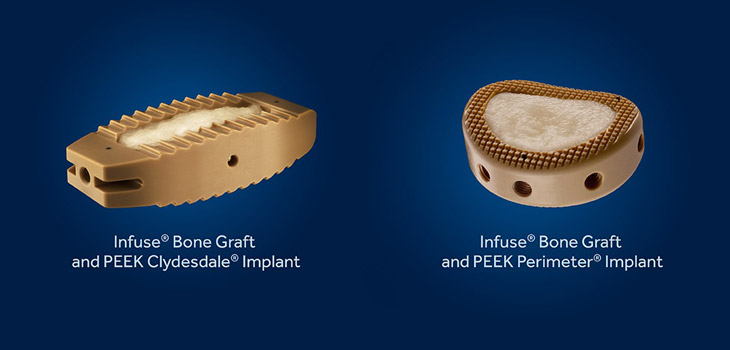
- Use in OLIF51 Procedures with certain sizes of the PEEK Perimeter Implant at a single level from L5-S1.
- Use in OLIF25 Procedures with certain sizes of the PEEK Clydesdale Implant at a single level from L2-L5.
- Use in ALIF procedures with certain sizes of the PEEK Perimeter Implant at a single level from L2-S1.
Peter Whang, M.D., FACS, an associate professor in the Department of Orthopaedics at the Yale School of Medicine in New Haven, Connecticut, said, “For my anterior and anterolateral lumbar spine fusion cases, the use of Infuse Bone Graft allows me to reliably obtain a solid arthrodesis without having to harvest bone from the patient’s own hip which generally requires a second incision, results in significant pain, and increases the risk of complications such as bleeding or infection.” He added that he believes that “the proven osteoinductive properties of Infuse Bone Graft are particularly beneficial when used in conjunction with PEEK interbody spacers and the less invasive OLIF technique, which circumvents the psoas muscle and minimizes disruption of the surrounding soft tissues and neural structures.”
Infuse
Infuse is used with certain Medtronic interbody fusion devices to treat lumbar degenerative disc disease. The company says the active ingredient in Infuse—rhBMP-2—is a manufactured version of a protein already present in the body that promotes new bone growth. During surgery, it is applied to an absorbable collagen sponge (ACS). The ACS is a carrier to deliver the rhBMP-2 to the implant site and acts as a scaffold for the formation of new bone, and it will resorb, or disappear, over time.
OLIF Procedure
According to the company, the OLIF25 procedure helps surgeons preserve the patient’s psoas muscle when treating the L2-L5 levels of the spine. Additionally, the procedure gives surgeons “easier access around the patient’s iliac crest – enabling placement of an implant into the disc space for anterior column support.” The OLIF51 Procedure provides lateral access to the L5-S1 disc space and doesn’t require surgeons to flip the patient from an anterior position during surgery.
The graft is not indicated for use with a trans-psoas surgical approach.
Infuse has been one of the most controversial products used off label in the spine. The company has been sued, maligned and accused of paying off surgeons to misrepresent clinical results. None of the accusations have stood up to independent scrutiny. With supplemental approval of these expanded indications, the company continues to build on the incremental progress of demonstrating the safety and effectiveness of the product.
Author
React:
Discussion
This is a fascinating development. In my practice we've seen similar outcomes with the revised protocol. The key differentiator seems to be patient selection criteria. Has anyone else noticed the correlation with BMI thresholds?
Great point. I'd push back slightly on the conclusion, the sample size in the cited study is too small to draw population-level inferences. That said, the directional signal is compelling and worth a larger RCT.
We implemented a similar approach last year. Early results are promising but we're still gathering 12-month follow-up data. Happy to share our protocol if anyone is interested.
Join the conversation
Orthopedic professionals are discussing this. Sign in and upgrade to read every comment and add your voice.