
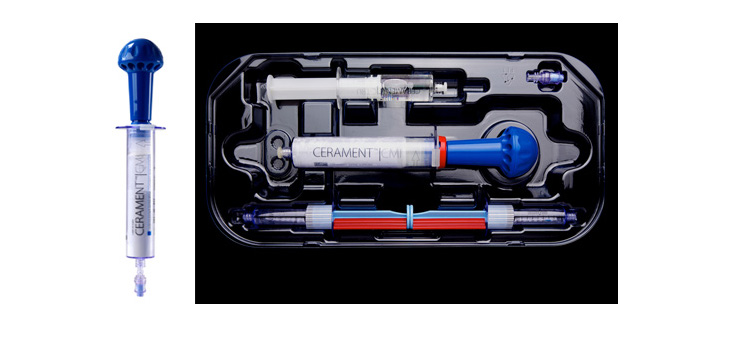
BONESUPPORT of Lund, Sweden, a manufacturer of injectable bone substitutes for orthopedic trauma, bone infections and instrument augmentation related to orthopedic surgery, reports that, in a pilot study, its Cerament has proven effective in the management of benign bone tumors. The December issue of Biomed Central Musculoskeletal Disorders published the results.
Cerament Succeeds as Tumor Bone Filler
1 min read Premium comments
Secondary
Company officials point out that surgical management of benign bone tumors can create a residual bone defect that requires void filling to prevent infection or fracture. The pilot study demonstrated full or partial cyst resolution with Cerament Bone Void Filler in 93% of the patients. There was complete cyst resolution in 11 of the 14 patients (78%) at the 12-month follow-up. The researchers reported no postoperative infections or fractures during the follow-up period.
“The immediate pain relief, full weight-bearing recovery, bone consolidation and incorporation as well as the structural bone integrity and durability demonstrated in the study indicate that CERAMENT can provide a safe and effective long-term solution for the treatment of benign bone tumors, making it an attractive alternative to autologous bone or allograft. Of special interest is the ability of percutaneous transcortical injection under fluoroscopy in patients with juvenile cysts, ” said Jacek Kaczmarcyk, M.D., Ph.D., Department of Orthopedics and Traumatology, Poznan University of Medical Sciences, Poznan, Poland, and principal investigator for the study.
Cerament Bone Void Filler is FDA cleared and CE-mark approved and commercially available in the U.S., Canada, parts of Europe, Southeast Asia and the Middle East. Zimmer Biomet is the exclusive distributor of the product in the U.S.
Author
React:
Discussion
This is a fascinating development. In my practice we've seen similar outcomes with the revised protocol. The key differentiator seems to be patient selection criteria. Has anyone else noticed the correlation with BMI thresholds?
Great point. I'd push back slightly on the conclusion, the sample size in the cited study is too small to draw population-level inferences. That said, the directional signal is compelling and worth a larger RCT.
We implemented a similar approach last year. Early results are promising but we're still gathering 12-month follow-up data. Happy to share our protocol if anyone is interested.
Join the conversation
Orthopedic professionals are discussing this. Sign in and upgrade to read every comment and add your voice.