
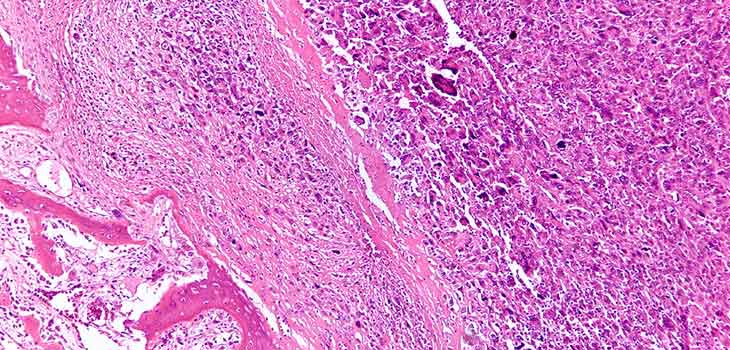
Osteosarcoma (OS), a rare cancer that primarily affects adolescents and children, originates in the bone tissue. Researchers from the University of Copenhagen have discovered that OS cells degrade the bone tissue through a completely different process than metastasized bone cancer.
Antibody Treatment Could Reduce Amputations in OS Patients
1 min read Premium comments
Secondary
Led by Dr. Niels Behrendt and Dr. Lars Engelholm, a team at the Finsen Laboratory, Rigshospitalet and BRIC has been able to use an antibody to block this process. In doing so, they reduced up to 80% of bone degradation in a mouse model. The hope is that using this antibody will lead to a reduction in amputations.
“A large proportion of new targeted cancer therapies are based on antibodies. We developed this antibody for basic studies of the molecule uPARAP, but when [sic] we discovered shown that this molecule is upregulated in OS tumours, we became interested in the possible treatment effect, ” said Dr. Behrendt in the December 2, 2015 news release.
Dr. Behrendt told OTW, “Research through the last few years has revealed that the receptor uPARAP/Endo180 is engaged in bone remodeling during normal bone growth. Cancer cells often ‘abuse’ the same molecules and cellular mechanisms as those working in the healthy tissue from which they are derived. This led to the idea that osteosarcoma (cancer cells derived from osteoblasts in the bone) might utilize the same receptor in bone degradation. We then showed that the receptor is indeed expressed on osteosarcomas (unlike most other cancer cells) and studies in a mouse model showed that we could counteract tumor-mediated bone degradation with an antibody against uPARAP/Endo180.”
“It may soon be possible to counteract osteosarcoma-mediated bone destruction in osteosarcoma patients by novel means of treatment. This should complement existing strategies (treatment with bisphosphonates, etc.) which are not sufficiently efficient. This is particular important as a strategy for neoadjuvant treatment where tumor destructive activity needs to be controlled during a period of chemotherapy prior to surgery.”
React:
Discussion
This is a fascinating development. In my practice we've seen similar outcomes with the revised protocol. The key differentiator seems to be patient selection criteria. Has anyone else noticed the correlation with BMI thresholds?
Great point. I'd push back slightly on the conclusion, the sample size in the cited study is too small to draw population-level inferences. That said, the directional signal is compelling and worth a larger RCT.
We implemented a similar approach last year. Early results are promising but we're still gathering 12-month follow-up data. Happy to share our protocol if anyone is interested.
Join the conversation
Orthopedic professionals are discussing this. Sign in and upgrade to read every comment and add your voice.