
There is a common narrative that device and drug companies sometimes fudge on reporting results from their clinical trials. Two cases, Medtronic plc and DePuy Synthes, come to mind over allegations the companies failed to report problems with Infuse and metal-on-metal hips.
Academic Institutions Fail Reporting Requirements
2 min read Premium comments
Secondary
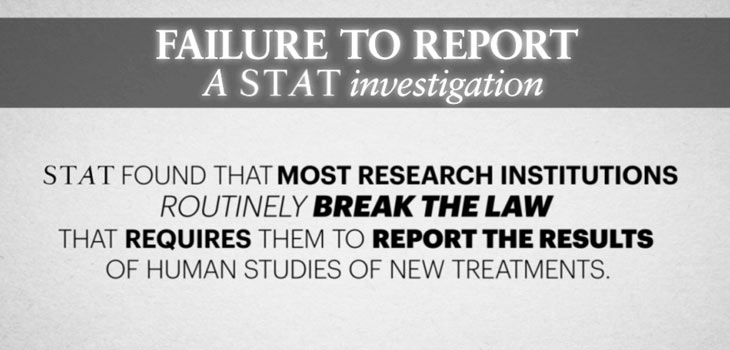
But a December 13, 2015 Statnews.com (Stat) investigation reported by the Association of Health Care Journalists has found that, “Stanford University, Memorial Sloan Kettering Cancer Center, and other prestigious medical research institutions have flagrantly violated a federal law requiring public reporting of study results, depriving patients and doctors of complete data to gauge the safety and benefits of treatments.” Stanford is the academic home of The Spine Journal editor Eugene Carragee, M.D. Carragee accused Medtronic of failing to report accurate study results of Infuse.
The Stat data included 98 universities, nonprofits, and corporations that served as sponsors or collaborators on at least 20 trials subject to federal disclosure requirements between 2008 and September 10, 2015. Stat downloaded ClinicalTrials.gov’s entire dataset of about 200, 000 trial records.
Worst Offenders
The worst reporting offenders included four of the top ten recipients of funding from the National Institutes of Health (NIH): Stanford, the University of Pennsylvania, the University of Pittsburgh, and the University of California, San Diego. “All disclosed research results late or not at all at least 95% of the time since reporting became mandatory in 2008.”
Only two entities—drug companies Eli Lilly and AbbVie—complied with reporting requirements more than half the time. Results from academic institutions arrived late or not at all 90% of the time, compared with 74% for industry. More than 25% of companies did better than all the universities and nonprofits.
The government can impose fines or suspend their research funding on institutions that fail to disclose trial results, . According to Stat, the government could have collected $25 billion from drug companies alone in the past seven years. But it has not levied a single fine.
NIH Director Dr. Francis Collins acknowledged that the findings are, “very troubling.”
Disclose or Publish?
In interviews with Stat, researchers, university administrators, and hospital executives said they are not intentionally undermining the law. “They said that they are simply too busy and lack administrative funding, and that they disclose some clinical trial results in medical journals and at conferences.”
Stanford supplied data to ClinicalTrials.gov for 26 of 82 trials for which results were due. Professors supplied data on time for only four studies. Dr. Harry Greenberg, senior associate dean for research at Stanford, told Stat his institution was determined to improve.
Several organizations told Stat that publishing in peer-reviewed medical journals is the highest form of disclosure of study results and should be sufficient, or that there should be a way to simply copy journal data into ClinicalTrials.gov. “Critics say such views reflect the primacy of scholarly articles for academic career advancement more than any inherent superiority over ClinicalTrials.gov.”
Stat’s investigation also reviewed the history and shortcomings of the entire ClinicalTrials.gov platform. To read the entire Stat story, click here.
Author
React:
Discussion
This is a fascinating development. In my practice we've seen similar outcomes with the revised protocol. The key differentiator seems to be patient selection criteria. Has anyone else noticed the correlation with BMI thresholds?
Great point. I'd push back slightly on the conclusion, the sample size in the cited study is too small to draw population-level inferences. That said, the directional signal is compelling and worth a larger RCT.
We implemented a similar approach last year. Early results are promising but we're still gathering 12-month follow-up data. Happy to share our protocol if anyone is interested.
Join the conversation
Orthopedic professionals are discussing this. Sign in and upgrade to read every comment and add your voice.