
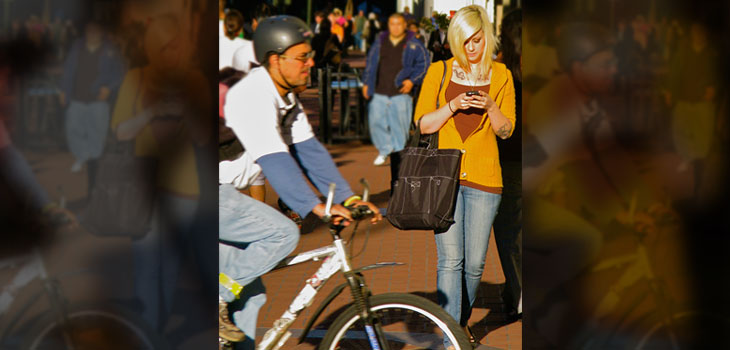
Maybe chewing gum is the ONLY thing we should be attempting while walking! A new study from the American Academy of Orthopaedic Surgeons (AAOS) shows that we have a long way to go to curb distracted walking. According to the December 2, 2015 news release, more than three quarters (78%) of U.S. adults believe that distracted walking is a “serious” issue; however, 74% of Americans say “other people” are usually or always walking while distracted, while only 29% say the same about themselves.
AAOS Study: Distracted Walking? That’s YOUR Problem
2 min read Premium comments
Secondary
Some results from the news release:
- 90% say they see walkers talking on the phone (and 37% admit doing so themselves)
- 88% are engaging in conversation (vs. 75% themselves)
- 88% are listening to music (vs. 34% themselves)
- 85% are using a smartphone (vs. 28% themselves)
- 64% are generally “zoning out, ” or not focused on walking (vs. 38% themselves)
“Today, the dangers of the ‘digital deadwalker’ are growing with more and more pedestrians falling down stairs, tripping over curbs, bumping into other walkers, or stepping into traffic causing a rising number of injuries—from scrapes and bruises to sprains and fractures, ” said Alan Hilibrand, M.D., AAOS spokesperson.
The news release indicates that, “Emergency department hospital visits for injuries involving distracted pedestrians on cell phones more than doubled between 2004 and 2010, according to a 2013 study appearing in the journal Accident, Analysis & Prevention.”
“The AAOS research, which involved more than 2, 000 respondents nationally and another 4, 000, total, in select urban areas, found that nearly four out of 10 Americans say they have personally witnessed a distracted walking incident, and just over a quarter (26%) say they have been in an incident themselves.”
Additionally, 500 people were surveyed in eight markets—New York, Los Angeles, Houston, Chicago, Phoenix, Seattle, Philadelphia and Atlanta. Among those findings:
- Among these eight markets, New York City residents are most likely to view distracted walking as a serious issue (86%), and Seattle residents were least likely to view the issue as serious (77%).
- New Yorkers are more likely to say they personally walk distracted (39%) than walkers living in the other cities.
- Residents of Chicago and Philadelphia are most likely to see distracted walking as “dangerous” (49%), while those in Houston were the least likely to think it’s dangerous (40%).
“The American Academy of Orthopaedic Surgeons urges pedestrians to avoid musculoskeletal and other injuries by engaging with their surroundings—drivers, bikers, other walkers and obstacles, ” said Dr. Hilibrand. “Many of us simply need to force ourselves to set down our devices and focus on what’s in front of and around us. This will ensure that we safely arrive at our destination, during this busy holiday season and throughout the year.”
Dr. Hilibrand told OTW, “Consider by comparison, how many people each year die in aircraft accidents. Or since it’s the topic of today, terrorism! There are more people in 2010 who died in distracted pedestrian related incidents than in any of those! People should be worried about this, and not assume it’s somebody else who is the problem.”
React:
Discussion
This is a fascinating development. In my practice we've seen similar outcomes with the revised protocol. The key differentiator seems to be patient selection criteria. Has anyone else noticed the correlation with BMI thresholds?
Great point. I'd push back slightly on the conclusion, the sample size in the cited study is too small to draw population-level inferences. That said, the directional signal is compelling and worth a larger RCT.
We implemented a similar approach last year. Early results are promising but we're still gathering 12-month follow-up data. Happy to share our protocol if anyone is interested.
Join the conversation
Orthopedic professionals are discussing this. Sign in and upgrade to read every comment and add your voice.