
Helen H. Lu, Ph.D., professor of biomedical engineering at Columbia Engineering, has won a three-year $1.125 million Translational Research Award grant from the Department of Defense’s (DoD) Congressionally Directed Medical Research Programs for her research on tendon-to-bone integration for rotator cuff repair. Dr. Lu is collaborating with William Levine, M.D., chairman and the Frank E. Stinchfield Professor of Orthopedic Surgery at Columbia University Medical Center. The funding is part of the DoD’s Orthopaedic Research Program.
$1.125 Million to Columbia for Rotator Cuff Repair
2 min read Premium comments
Secondary
“This is the culmination of our decade-long, interdisciplinary collaboration on integrative rotator cuff repair, ” said Dr. Lu in the December 15, 2015 news release. “What is truly exciting is that the work planned in this new project will bring our novel technology another major step closer to clinical realization.”
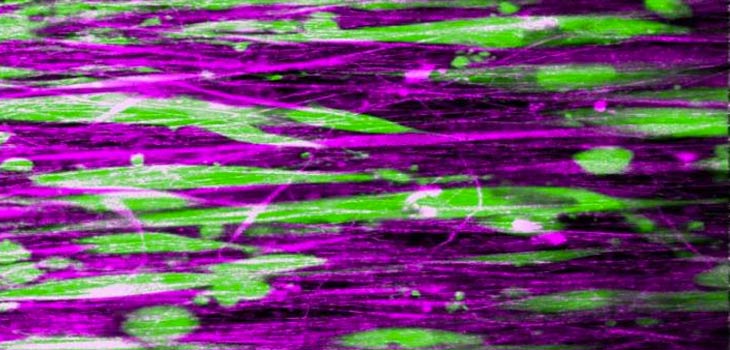
As indicated in the news release, “Current clinically available strategies, such as graft patches, provide initial stability to tendons, but ultimately they lack the mechanical integrity and structural make-up necessary for tendon-bone healing. These disadvantages have significantly limited their clinical use. In contrast, the bioinspired technology developed by Drs. Lu and Levine is based on organized nanofibers (aligned and parallel to each other) that enable the integrative repair of rotator cuff tears by targeting the regeneration of the layered tendon-to-bone interface.”
Asked what makes their approach so exciting, Dr. Lu told OTW, “There are several aspects of our device that differentiate our solution from existing and emerging approaches. Among the most compelling: Ours is the first graft to demonstrate true biological integration of the rotator cuff tendon with bone. We are using an inlay versus onlay approach, which represents an entirely new approach to cuff healing. Our graft relies on a proprietary, synthetic design that mimics the organization of native tendon and enthesis collagen fibers. In addition, we are working on tools to allow minimally invasive surgical implantation.”
“The acellular graft design has been validated in both small and large animal models and is ready for consideration by the FDA for approval. This grant enables us to investigate the next generation design of the integration graft which will expedite tendon-bone healing through growth factor release and use of autologous stem cells.”
“One of the challenges that we face, which is beyond the scope of our academic lab and clinical expertise, is manufacturing for clinical studies. We are seeking partners with electrospinning experience who can manufacture, sterilize, and package our device in compliance with applicable regulations.”
“Our device has significant potential to reduce the high failure rate associated with current repair of large cuff tears and minimize the need for revision surgeries. We feel that this technology is applicable to any procedure where soft tissue to bone integration is critical for success—rotator cuff repair, Achilles tendon repair, and distal biceps tendon repair for example.”
React:
Discussion
This is a fascinating development. In my practice we've seen similar outcomes with the revised protocol. The key differentiator seems to be patient selection criteria. Has anyone else noticed the correlation with BMI thresholds?
Great point. I'd push back slightly on the conclusion, the sample size in the cited study is too small to draw population-level inferences. That said, the directional signal is compelling and worth a larger RCT.
We implemented a similar approach last year. Early results are promising but we're still gathering 12-month follow-up data. Happy to share our protocol if anyone is interested.
Join the conversation
Orthopedic professionals are discussing this. Sign in and upgrade to read every comment and add your voice.