
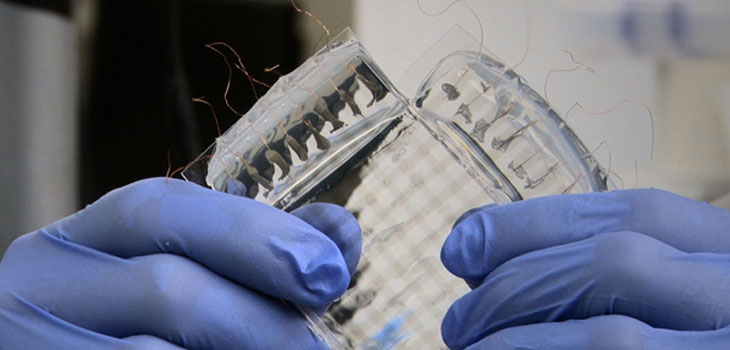
Scientists at Stanford University are working to develop an artificial skin for prosthetics that can detect pressure and send signals to brain cells. According to Emily Wasserman, writing for Fierce Medical Devices, Zhenan Bao, Ph.D. and her team of engineers have created a skin-like material that consists of two layers. The elastic top layer holds carbon nanotubes that can detect pressure and conduct electricity. A second layer, under the first one, uses inkjet technology to translate the messages—messages similar to Morse code.
Prosthetic ‘Skin’ Communicates With Brain Cells
1 min read Premium comments
Secondary
When more pressure is applied to the outside layer more frequent electrical impulses come through. Removing the pressure stops the impulses. A battery powers the device.
To prove that the artificial skin could communicate with the brain, the scientists created a line of neurons to simulate the nervous system. They then changed the electronic pressure signals into light pulses. The pulses activated the neurons which, like a row of dominoes falling down, demonstrated that the skin could generate a neurological response.
Bao said, “This is the first time a flexible, skin-like material has been able to detect pressure and also transmit a signal to a component of the nervous system.”
Wasserman noted that in Bao’s previous work she and her team had created a tiny sensor that measured brain pressure in mice. The device also read a team member’s pulses without touching him—an invention that ties into the movement toward wearable monitors and alternative materials for prosthetics.
Author
React:
Discussion
This is a fascinating development. In my practice we've seen similar outcomes with the revised protocol. The key differentiator seems to be patient selection criteria. Has anyone else noticed the correlation with BMI thresholds?
Great point. I'd push back slightly on the conclusion, the sample size in the cited study is too small to draw population-level inferences. That said, the directional signal is compelling and worth a larger RCT.
We implemented a similar approach last year. Early results are promising but we're still gathering 12-month follow-up data. Happy to share our protocol if anyone is interested.
Join the conversation
Orthopedic professionals are discussing this. Sign in and upgrade to read every comment and add your voice.