
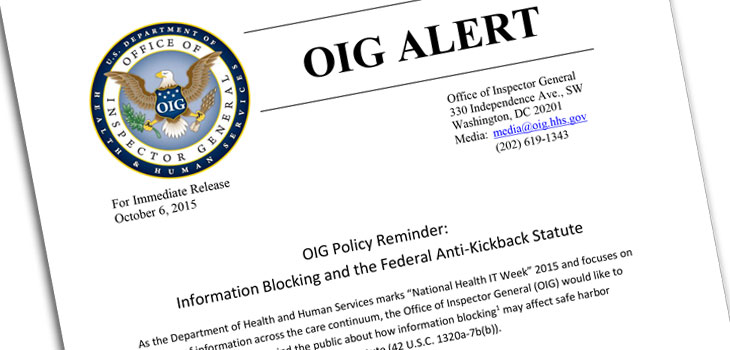
Patient information can be a powerful competitive advantage between providers fighting over those patients. On October 6, 2015, the Office of Inspector General (OIG) issued a new alert to make sure providers don’t abuse that information and run afoul of the Anti-Kickback Statute (AKS).
OIG Warns Providers Over Information Blocking
2 min read Premium comments
Secondary
The government has spent billions of dollars to promote the adoption of “meaningful use” of health information technology and ensure the electronic exchange of patient information. The Department of Justice even included a safe harbor exemption under the AKS for electronic health record (EHR) for such adoption.
Electronic Health Record Safe Harbor
The EHR Safe Harbor, according to lawyers from McDermott Will & Emery, permits certain healthcare providers and other donors to pay up to 85% of the cost of EHR technology provided to a physician practice or other referral source if the arrangement meets all EHR Safe Harbor elements. The third element of that safe harbor requires that “The donor (or any person on the donor’s behalf) does not take any action to limit or restrict the use, compatibility, or interoperability of the items or services with other electronic prescribing or electronic health records systems (including, but not limited to, health information technology applications, products, or services).”
Information Blocking
Why might a provider restrict use of, or even block certain patient information? To prevent a competitor from getting that information.
But the OIG got wise to that possibility and issued the alert warning providers that health information blocking can impact whether the AKS harbor remains safe.
When the OIG amended the EHR Safe Harbor in 2013, it stated in the preamble to the final rule, that “[D]onors must offer interoperable products and must not impede the interoperability of any electronic health record software they decide to offer…Agreements between a donor and a vendor that preclude or limit the ability of competitors to interface with the donated software would cause the donation to fail to meet the condition” of the safe harbor, and, “thus preclude protection under the electronic health records safe harbor.”
The McDermott lawyers say the OIG alert cites several examples of information blocking that would threaten protection under the EHR Safe Harbor. “For example, if a provider limits the use or interoperability of software by agreeing with the potential referral source to prevent a competitor from interfacing with the software, the safe harbor requirements would not be satisfied. Likewise, if the software vendor agrees with a provider to charge high interface fees to outside providers or suppliers or to competitors, the safe harbor requirements may not be satisfied.”
The lawyers advise providers that in order to avoid running afoul of the AKS (and resulting False Claims Act claims), when offering physician practices or other referral sources below-cost EHR technology, they should “take care to avoid health information access restrictions that unreasonably interfere with access to information for continuity of care or other appropriate purposes and, thereby, threaten EHR Safe Harbor protection.”
To read the entire OIG document, click here.
Author
React:
Discussion
This is a fascinating development. In my practice we've seen similar outcomes with the revised protocol. The key differentiator seems to be patient selection criteria. Has anyone else noticed the correlation with BMI thresholds?
Great point. I'd push back slightly on the conclusion, the sample size in the cited study is too small to draw population-level inferences. That said, the directional signal is compelling and worth a larger RCT.
We implemented a similar approach last year. Early results are promising but we're still gathering 12-month follow-up data. Happy to share our protocol if anyone is interested.
Join the conversation
Orthopedic professionals are discussing this. Sign in and upgrade to read every comment and add your voice.