
Nexxt Spine, LLC launched its DT Elite Guide System on November 17, 2015.
Nexxt Spine Launches Guide System
1 min read Premium comments
Secondary
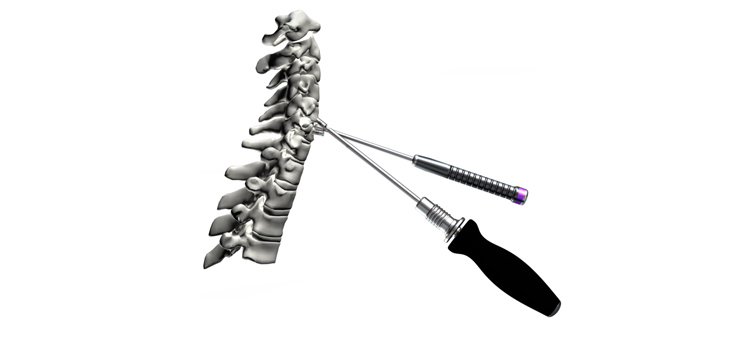
The company claims the guides reduce the number of operative steps during an anterior cervical discectomy and fusion (ACDF) procedure because the surgeon can determine the appropriate interbody dimensions and prepare screw pilot holes for the anterior plate simultaneously. The system, according to the company, “bridges the gap” between its Struxxure Anterior Cervical Plate and Honour Cervical Interbody systems.
The Struxxure system’s design rationale is based on published papers highlighting studies reporting the incidence of adjacent level ossification (ALO) significantly decreases when the plate-to-disc distance is greater than 5 millimeters from the adjacent level. According to Dr. Robert L. Wertz, the company’s new product development vice president, “The innovative Struxxure DT Elite Guides simplify the ACDF procedure and provide the framework for a shorter plate to be used which in turn increases the distance to the adjacent disc level wherein studies report a reduction in the risk of developing postoperative degenerative changes, including ALO.”
The DT Elite System is manufactured using 3-D printing technology.
The company is headquartered in Noblesville, Indiana, and started with its first surgical case in 2009. It now has 16 product lines available for sale within the U.S., with 100% of all spinal implants and 95% of surgical instruments manufactured onsite at its Noblesville facility.
Having onsite manufacturing capabilities allows the company to accelerate new product development by eliminating dependence on outside vendors. Prototypes leading to final implant and surgical instrument design are accomplished in a matter of days compared to the industry standard of weeks to months.
Author
React:
Discussion
This is a fascinating development. In my practice we've seen similar outcomes with the revised protocol. The key differentiator seems to be patient selection criteria. Has anyone else noticed the correlation with BMI thresholds?
Great point. I'd push back slightly on the conclusion, the sample size in the cited study is too small to draw population-level inferences. That said, the directional signal is compelling and worth a larger RCT.
We implemented a similar approach last year. Early results are promising but we're still gathering 12-month follow-up data. Happy to share our protocol if anyone is interested.
Join the conversation
Orthopedic professionals are discussing this. Sign in and upgrade to read every comment and add your voice.