
Here is one of the best ideas we’ve seen in a long time.
Medical Memory Videotapes Office Visits
2 min read Premium comments
Secondary
We all know that communication between a physician and his patient is critical. That 20-minute conversation between a surgeon and his patient, at the end of an examination, is often the most important and problematic part of the visit to a doctor.
Some patients forget up to 80% of what their doctor tells them.
Not grasping what the doctor is trying to tell a patient is often due to the complicated subject matter and the emotionally charged nature of some patient visits. Others bring a family member or a friend with them to help them remember precisely what the doctor is telling them.
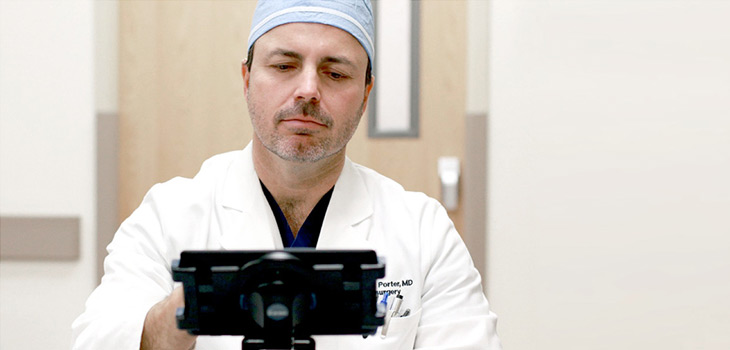
Medical Memory founder Randall Porter, M.D., a neurosurgeon at Barrow Neurosurgical Associates in Phoenix, Arizona, has come up an easy and great solution to the problem of communicating with patients. Record the medical visit.
Medical Memory is an easy-to-use system which allows a doctor to record on video his advice and instructions to his patients. The device, a small tablet on a stand, can be moved around to show specific visuals, x-rays and everything else the doctor wants to communicate to his patient.
OTW talked with David Ott, M.D. an orthopedic surgeon with OrthoArizona, working in Phoenix, who has used Medical Memory for a year. He said that when a patient comes to his practice he is asked if he wants a video of the visit. If the patient agrees, he signs up on a tablet and creates a password. When he returns home, the patient will get an email message from Medical Memory that explains how he can access the video and audio recording of his visit with his doctor. The video can be shared with family members and care givers.
Ott explained how the program helped him deal with the family of a young patient who had a benign tumor on his knee. The young man called his mother, a nurse in another city to tell her that he had a tumor on his knee. The mother, in a panic, called Ott who was able to show her the video of his examination and reassure her that her son was going to be all right.
Ott says that “the simplicity of the system is its major advantage.” While he appreciates the video, he believes that the audio portion is the more important. “My practice is about shared decision making. This allows me to continue this, ” he said.
Porter explained, “Our app’s recording work flow fits seamlessly within the normal doctor-patient interaction and our secure website gives patients convenient access to their videos and makes it simple to share with caregivers.” He added that the site is designed to “reduce readmissions and malpractice risks.”
Author
React:
Discussion
This is a fascinating development. In my practice we've seen similar outcomes with the revised protocol. The key differentiator seems to be patient selection criteria. Has anyone else noticed the correlation with BMI thresholds?
Great point. I'd push back slightly on the conclusion, the sample size in the cited study is too small to draw population-level inferences. That said, the directional signal is compelling and worth a larger RCT.
We implemented a similar approach last year. Early results are promising but we're still gathering 12-month follow-up data. Happy to share our protocol if anyone is interested.
Join the conversation
Orthopedic professionals are discussing this. Sign in and upgrade to read every comment and add your voice.