
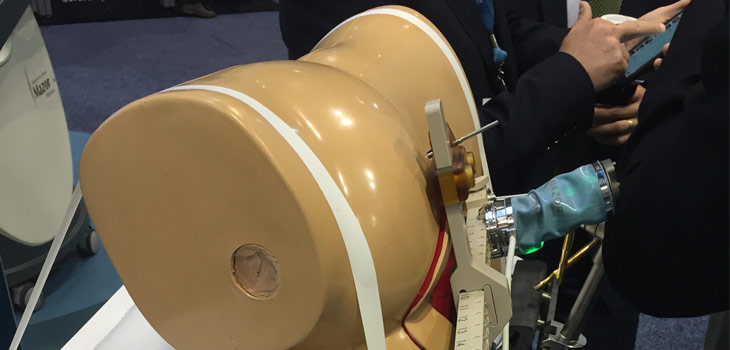
And now, a world’s first on a cadaver…Mazor Robotics, Ltd. has just showcased its PROlif Lateral solution on a cadaver at the Society for Minimally Invasive Spine Surgery (SMISS) Global Forum ’15. Additionally, the company has—for the first time—presented data for the PROlif.
Mazor Robotics Showcases PROlif
1 min read Premium comments
Secondary
According to the November 9, 2015 news release, “A podium presentation entitled, Comparison Of Fluoro-guided vs. Robotic-guided Single-position Lateral Interbody Fusion and Posterior Fixation—A Preliminary Report, reported fluoroscopy time per screw was reduced by approximately one-third when Mazor Robotics technology was used. Neurosurgeon J. Alex Thomas, M.D. also reported zero revisions in those cases compared to three revisions in the fluoro-guided group.”
“The Renaissance Guidance System easily integrates into my existing operating workflow and when using PROlif, it saves 45-60 minutes of anesthesia- and surgical time per case, ” said SMISS Co-Chairman Kornelis Poelstra, M.D., Ph.D. “This improved efficiency means for us a clinically significant reduction in complication risk, in addition to the economic benefits for our institution. It typically amounts to enough time savings over two cases that I can perform an additional surgery that same day without ever compromising patient outcomes.”
Dr. Poelstra led a cadaver workshop to at the SMISS.
“The interest we have seen in our PROlif Lateral solution illustrates that it is quickly gaining momentum and its value is being seen by many in the industry, ” said Ori Hadomi, chief executive officer of Mazor Robotics. “Mazor’s mission to heal through innovation is being realized when we introduce new solutions that improve both the patient and surgeon experience, as Dr. Poelstra has stated.”
Asked about questions and comments they received from the SMISS audience, Hadomi told OTW, “How much time can be saved in the OR? Could you use this new product to also position the cage? How complicated is the workflow and how cumbersome is the technology? Do you need to change anything in the current surgical technique?”
Hadomi added, “We are planning for a full commercial release in 2016 after final design optimization for all tools and accessories is complete.”
Author
React:
Discussion
This is a fascinating development. In my practice we've seen similar outcomes with the revised protocol. The key differentiator seems to be patient selection criteria. Has anyone else noticed the correlation with BMI thresholds?
Great point. I'd push back slightly on the conclusion, the sample size in the cited study is too small to draw population-level inferences. That said, the directional signal is compelling and worth a larger RCT.
We implemented a similar approach last year. Early results are promising but we're still gathering 12-month follow-up data. Happy to share our protocol if anyone is interested.
Join the conversation
Orthopedic professionals are discussing this. Sign in and upgrade to read every comment and add your voice.