
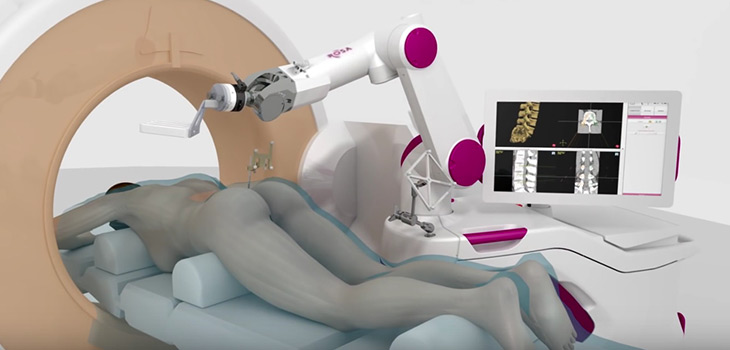
France-based Medtech S.A., has obtained a $15 million commitment to develop its ROSA Brain and ROSA Spine surgical assistance robots. ROSA Spine is a robotic assistive device for minimally invasive spine surgery.
French Spine Robotic Maker Obtains $15 Million
1 min read Premium comments
Secondary
The company announced on November 2, 2015 that Ally Bridge Group, a global healthcare-focused investment group made the commitment through the purchase of convertible notes maturing in 2020 and warrants to purchase shares of the company.
Bertin Nahum, Medtech’s founder and CEO, said the investment “comes at a key juncture on the company’s development.” He said the company has been building momentum for ROSA adoption in neurosurgery on a global basis and is in the “early stages” of launching ROSA for spine surgery and is “on track” for FDA clearance for ROSA spine “in the coming months.”
The ROSA system, according to Nahum, addresses a range of pathologies for both the brain (epilepsy, Parkinson’s disease, tumors, etc.) and the spinal column (degenerative spine disease, tumors, etc.).
The company claims ROSA is the only robotic assistant approved for neurosurgical procedures in clinical use in Europe, the U.S. and Canada.
As of June 30, 2015, the company had placed 48 ROSA robots worldwide (including 20 during the 2015 fiscal period). During the past quarter, it sold its first ROSA spine robot to Amiens University Hospital in France.
Founded in 2002 by Nahum and based near Montpellier, France, the company developed ROSA for brain surgery procedures in 2007.
In 2013 Medtech received the “European Company of the Year Award” in the “robotic neurosurgery” category from Frost & Sullivan. In July 2014, the company obtained the CE marking for ROSA Spine. In October 2014, the company won the “Révélation” prize in the Mediterranean Deloitte Technology Fast 50 Awards
While the company has won awards and funding, it’s still waiting to make a profit. For its 2015 fiscal year, the company reported revenue of 6.5 million Euros and an operating loss of approximately 3.3 million Euros.
Author
React:
Discussion
This is a fascinating development. In my practice we've seen similar outcomes with the revised protocol. The key differentiator seems to be patient selection criteria. Has anyone else noticed the correlation with BMI thresholds?
Great point. I'd push back slightly on the conclusion, the sample size in the cited study is too small to draw population-level inferences. That said, the directional signal is compelling and worth a larger RCT.
We implemented a similar approach last year. Early results are promising but we're still gathering 12-month follow-up data. Happy to share our protocol if anyone is interested.
Join the conversation
Orthopedic professionals are discussing this. Sign in and upgrade to read every comment and add your voice.