
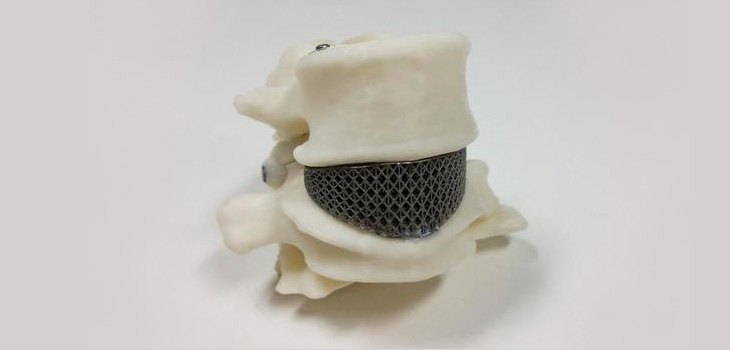
Australian surgeon has implanted his country’s first 3D-printed vertebral spinal cage. The surgery took place in the back of patient Amanda Gorvin whose lumbar vertebra has an unusual shape. Marc Coughlan, M.D., of the North Gosford and Prince of Wales Hospitals performed the surgery.
Doc Implants First 3D Spinal Cage in Australia
1 min read Premium comments
Secondary
The abnormal structure of her fifth lumbar vertebra and severe degeneration of the adjacent disc was causing Gorvin constant lower back pain. Coughlan believed that spinal surgery was an option, but because of the unusual shape of the patient’s vertebrae he worried that a standard, off-the-shelf implant would not give the patient much relief from her pain.
He turned to Melbourne medical device specialists, Anatomics Pty Ltd, to design and develop a custom-made titanium spinal implant using 3D printing.
“This revolutionary process allows the implant to be built layer by layer, adding successive layers of material under computer control—as opposed to the subtractive manufacturing techniques of casting, fabrication, stamping and machining, ” said Milan Brandt a professor at RMIT University of Melbourne’s Centre for Additive Manufacturing. “An advantage of 3D printing is that a custom implant can be made of any shape and complex internal architecture for a reasonable cost.”
It has now been three months since the surgery and Gorvin is reported to have resumed normal activities without any significant pain.
Author
React:
Discussion
This is a fascinating development. In my practice we've seen similar outcomes with the revised protocol. The key differentiator seems to be patient selection criteria. Has anyone else noticed the correlation with BMI thresholds?
Great point. I'd push back slightly on the conclusion, the sample size in the cited study is too small to draw population-level inferences. That said, the directional signal is compelling and worth a larger RCT.
We implemented a similar approach last year. Early results are promising but we're still gathering 12-month follow-up data. Happy to share our protocol if anyone is interested.
Join the conversation
Orthopedic professionals are discussing this. Sign in and upgrade to read every comment and add your voice.