
The FDA has granted clearance to Prosidyan, Inc.’s fiber-based bioactive glass products for use in postero-lateral fusion.
Bioactive Glass Cleared for Postero-Lateral Fusion
2 min read Premium comments
Secondary
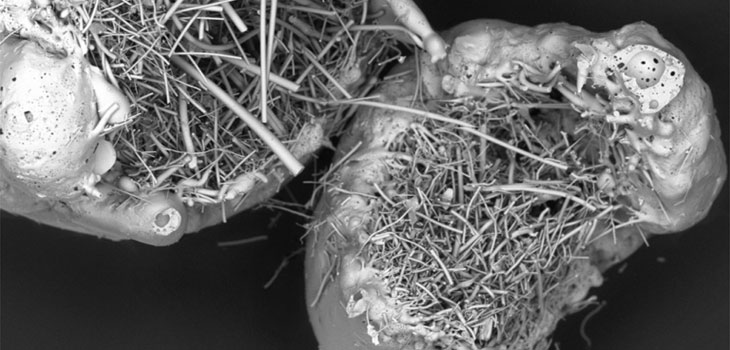
The company’s Fibergraft BG Morsels, ultra-porous bone graft substitutes, are made entirely from 45S5 bioactive glass microfibers and microspheres.
Hyun Bae, M.D., is the company’s chief medical officer. In a November 16, 2015 announcement Bae said the product is, “the next generation of synthetic bone grafting for spine.” He noted that synthetic bone grafts have been “stagnant” for 20 years using the same porous technology. “Fibergraft is the exclusive synthetic bone graft which uses bioactive glass fibers to provide direct connectivity. This is a paradigm shift in synthetic bone grafting.”
According to the company, its bone graft substitute is indicated only for bony voids or gaps that are not intrinsic to the stability of the bony structure. The product “is indicated to be gently packed into bony voids or gaps of the skeletal system (i.e., postero-lateral spine, extremities and pelvis). These defects may be surgically-created osseous defects or osseous defects created from traumatic injury to the bone. The product provides a bone void filler that resorbs and is replaced with bone during the healing process.” The product must be used with autogenous bone marrow aspirate and autograft in the postero-lateral spine.
Company President and CEO Charanpreet Bagga said the spine is where the majority of bone grafting is done and where there is an unmet clinical need. “There are very few synthetic bone grafts with FDA clearance for postero-lateral spinal fusion. We believe that Fibergraft, mixed with autograft and bone marrow aspirate will be a great option for the spine surgeons.”
Bioactive Glasses
Bioactive glasses have been widely researched over the last few decades for application in bone repair and are receiving increasing interest for applications in soft tissue repair. According to a study published in the December 12, 2014 issue of Journal of Materials Science: Materials in Medicine, bioactive glass has a well-recognized ability to enhance bone formation and to form a strong bond with hard and soft tissue. “When implanted in the body, bioactive glass reacts with the body fluids, releasing ions into the fluids, and converts to hydroxyapatite (HA), the main mineral constituent of bone, which is responsible for the formation of the firm bond with hard and soft tissue.”
The company was founded in 2009. The product has been on the market for over 18 months and was first cleared by the FDA in March 2014. The first implantation was performed in May 2014.
A second product line called Fibergraft BG Putty delivers the product through a Prosidyan proprietary bioactive carrier, called Ossiglide.
Author
React:
Discussion
This is a fascinating development. In my practice we've seen similar outcomes with the revised protocol. The key differentiator seems to be patient selection criteria. Has anyone else noticed the correlation with BMI thresholds?
Great point. I'd push back slightly on the conclusion, the sample size in the cited study is too small to draw population-level inferences. That said, the directional signal is compelling and worth a larger RCT.
We implemented a similar approach last year. Early results are promising but we're still gathering 12-month follow-up data. Happy to share our protocol if anyone is interested.
Join the conversation
Orthopedic professionals are discussing this. Sign in and upgrade to read every comment and add your voice.