
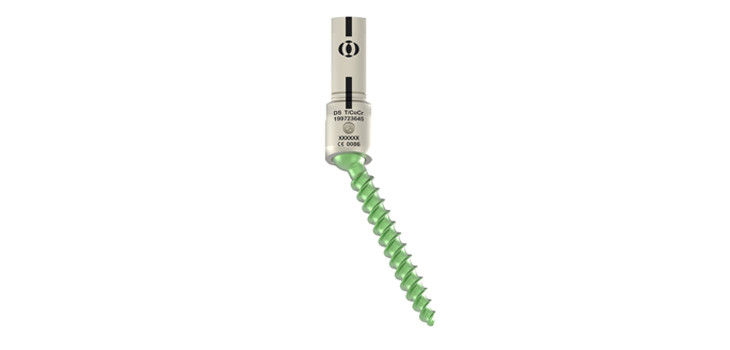
DePuy Synthes Spine has a new all-in-one pedicle screw system called the Expedium Verse Spinal System.
All-In-One Pedicle Screw System from DePuy Synthes
2 min read Premium comments
Secondary
By potentially reducing the number of screws needed in a procedure, the company claims the Expedium system allows surgeons to perform multiple maneuvers during fusion surgery with a single implant type and fewer instruments.
The system touts an innovative “Correction Key” which enables conversion to multiple screw types, “which expands implant functionality, provides interorperative flexibility” and therefore offers the possibility of fewer screws. The number of instrument trays per procedure can be reduced to as few as four and helps reduce sterilization costs by 84%. With these features, the company hopes to reduce procedure time.
Suken A. Shah, M.D., division chief, Spine and Scoliosis Center, Nemours/Alfred I duPont Hospital for Children, Wilmington, Delaware, believes the system, “may fundamentally change the way surgeons approach scoliosis by offering any number of ways to engage the rod and derotate the spine in order to truly achieve three dimensional correction. Set consolidation and limited need for ancillary instruments improve operating room efficiency and provide additional value for the hospital through easier adoption, faster turnover, and less sterilization demands.”
According to the company, increased screw head angulation and reduction tabs optimize rod placement and “may help reduce over-bending of the rod during implantation, which can lead to rod fatigue.” In addition, improved control over screw positioning and improved distribution of forces “may help reduce the risk of screw pullout or migration when compared to traditional screws.” When used to treat degenerative disorders of the mid- and lower-back, the increased angulation of the Expedium pedicle screw “may allow for less tissue retraction.”
Scale and Value
DePuy Synthes Spine’s platform leader, Dan Wildman said the company’s goal was to develop an implant-based system that would benefit patients while supporting procedural efficiency and value. “We have achieved that goal.”
The company also has scale in mind by selling the Expedium as part of a comprehensive package that provides hospitals with a single source to address complex spine needs. In collaboration with Ethicon, the company is offering the Harmonic Osteovue Spine Soft Tissue Dissector exclusively to spine surgeons, who also have access to Stratafix Symmetric PDS Synthetic Absorbable Sutures for suture closure and Dermabond Prineo for wound closure. Externally, the company is working with Brainlab to offer distinct navigation solutions and with LifeNet Health to offer ViviGen Cellular Bone Matrix (one of the 2015 Orthopedics This Week Spine Technology Award winners).
Author
React:
Discussion
This is a fascinating development. In my practice we've seen similar outcomes with the revised protocol. The key differentiator seems to be patient selection criteria. Has anyone else noticed the correlation with BMI thresholds?
Great point. I'd push back slightly on the conclusion, the sample size in the cited study is too small to draw population-level inferences. That said, the directional signal is compelling and worth a larger RCT.
We implemented a similar approach last year. Early results are promising but we're still gathering 12-month follow-up data. Happy to share our protocol if anyone is interested.
Join the conversation
Orthopedic professionals are discussing this. Sign in and upgrade to read every comment and add your voice.