
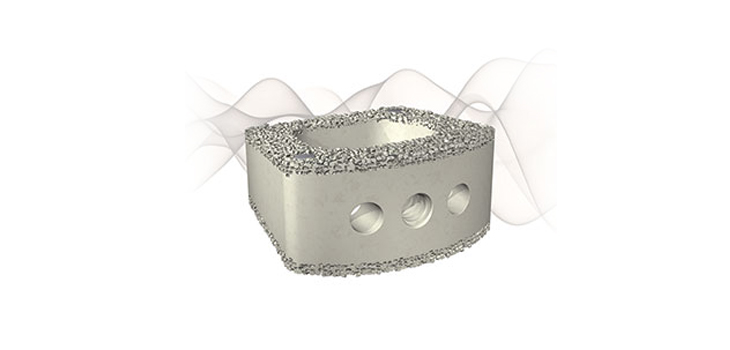
Vertera Spine has received U.S. Food and Drug Administration 510(k) clearance for a uniquely osteoconductive and porous PEEK Cervical Interbody Fusion Device called simply COHERE.
Uniquely Osteoconductive and Porous PEEK Device Gets FDA Nod
2 min read Premium comments
Secondary
The implant’s proprietary surface technology is porous and is based on Zeniva PEEK resin from Solvay Specialty Polymers.
Several PEEK implants with porous or rough metal coatings are in use today. But COHERE is the first FDA cleared spinal implant manufactured entirely out of PEEK which also is porous.
Co-founder and CEO of Vertera Spine Chris Lee, Ph.D., told OTW, “Our primary development objective for COHERE was to address the biologic challenges associated with current PEEK devices while keeping manufacturing costs low. Numerous companies have tried to make PEEK more osteoconductive by adding materials like titanium to the implant surface or hydroxyapatite to the bulk material. These offerings have several inherent problems related to their mechanical durability and cost associated with added material.”
“We took a fundamentally different approach by growing a porous PEEK network directly from COHERE’s surface, thus maintaining PEEK’s advantageous mechanical properties, while also allowing bone to mechanically interlock directly within the porosity without eliciting fibrous encapsulation. In the end, we believe we have developed an elegant, more cost-effective solution with superior mechanical and biological performance that can also be advantageous for implants outside of spine.”
The underlying technology for COHERE, PEEK Scoria, “represents a breakthrough in how surface technologies are applied to medical devices, ” according to Dr. Lee. The PEEK Scoria technology came from research conducted at Duke University and the Parker H. Petit Institute for Bioengineering and Bioscience at Georgia Institute of Technology.
Unlike other PEEK surface treatments that are coated onto the device, Scoria is grown directly out of the solid PEEK Zeniva material. As a result, the implant has a seamless surface-to-solid material interface. The company believes that this type of PEEK implant surface is more durable than metal coatings and two times stronger under shear loading than trabecular bone.
Because PEEK Scoria can be fabricated onto the device without using any additive material, manufacturing costs are lower than metal-coated implants which should result in more competitive pricing as compared with more traditional coated PEEK implants or even titanium-coated fusion devices.
“The FDA clearance of COHERE represents a significant milestone for Vertera Spine and fusion devices in spine, ” said Dr. Lee. “Given the new economics of healthcare, market demands are shifting towards more effective implant technologies at a better price. COHERE, featuring surface porous PEEK Scoria, will be the first in a new generation of biomedical implant innovations to meet this demand.”
Vertera Spine is a privately held medical device company working to develop and commercialize a portfolio of surgical solutions that use or complement its patented porous surface technology to address critical clinical needs in spine procedures.
Solvay Specialty Polymers is a global supplier of high-performance thermoplastics offered for use in permanent and prolonged exposure implants and limited exposure devices. Solvay is an international chemical group headquartered in Brussels. Its companies employ about 29, 400 people in 55 countries.
Author
React:
Discussion
This is a fascinating development. In my practice we've seen similar outcomes with the revised protocol. The key differentiator seems to be patient selection criteria. Has anyone else noticed the correlation with BMI thresholds?
Great point. I'd push back slightly on the conclusion, the sample size in the cited study is too small to draw population-level inferences. That said, the directional signal is compelling and worth a larger RCT.
We implemented a similar approach last year. Early results are promising but we're still gathering 12-month follow-up data. Happy to share our protocol if anyone is interested.
Join the conversation
Orthopedic professionals are discussing this. Sign in and upgrade to read every comment and add your voice.