
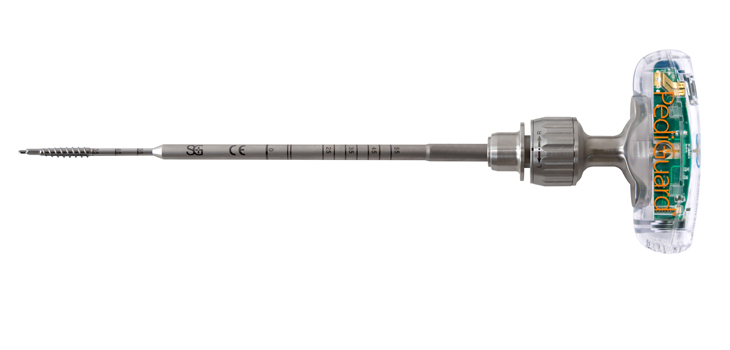
Spine news from France…SpineGuard, developers of disposable medical devices for the spine, has announced today the CE marking for its DSG Threaded Drill and the first surgery, a thoracolumbar scoliosis correction, in Lille’s Centre Hospitalier Universitaire by Dr.s Assaker, Chopin and Allaoui.
SpineGuard Receives CE Mark for Drill, Announces First Surgery
1 min read Premium comments
Secondary
“As a long-standing user of PediGuard probes, I find that this smart threaded drill is a useful technical improvement. It allows to prepare the entry point, redirect the trajectory when needed and remain in cancellous bone, ” said Richard Assaker, M.D., Professor of Neurosurgery at Centre Hospitalier Universitaire de Lille, France, in the September 30, 2015 news release. “If appropriate, we can also cross the cortical wall with a very high level of precision.”
Stéphane Bette, CTO and co-founder of SpineGuard, added, “This novel application of our DSG [Dynamic Surgical Guidance] technology is the fruit of a close collaboration between our R&D team and our expert consulting surgeons. In line with healthcare systems expectations, SpineGuard continues to bring to market disruptive products designed to enhance the safety and efficiency of surgical procedures.”
Asked about the most challenging aspect of developing the drill, CEO Pierre Jerome told OTW, “We had to miniaturize our sensor to properly embed our Dynamic Surgical Guidance technology into a cannulated shaft and come up with a novel tip and thread designs to allow the device to engage into bone without skiving and to redirect the trajectory if necessary.”
“In one year from now, I hope our DSG threaded drill will have started to clearly demonstrate its clinical value for the accurate and efficient placement of pedicle screws with minimal radiographic control. By then, it should significantly contribute to our revenue growth and be hopefully cleared in the U.S. as well as in some other non-European countries.”
React:
Discussion
This is a fascinating development. In my practice we've seen similar outcomes with the revised protocol. The key differentiator seems to be patient selection criteria. Has anyone else noticed the correlation with BMI thresholds?
Great point. I'd push back slightly on the conclusion, the sample size in the cited study is too small to draw population-level inferences. That said, the directional signal is compelling and worth a larger RCT.
We implemented a similar approach last year. Early results are promising but we're still gathering 12-month follow-up data. Happy to share our protocol if anyone is interested.
Join the conversation
Orthopedic professionals are discussing this. Sign in and upgrade to read every comment and add your voice.