
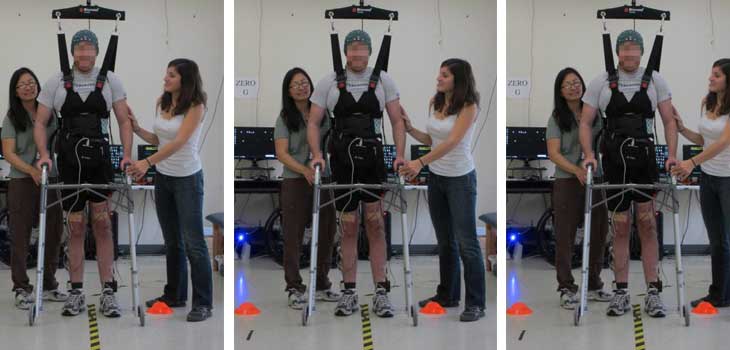
A man who was paralyzed for five years due to a spinal cord injury is now able to walk. Using the power of his own brain, the man achieved this without use of manually controlled robotic limbs. The research, published in the open access Journal of NeuroEngineering and Rehabilitation, involved an electroencephalogram (EEG) based system. The system employs electrical signals from the participant’s brain, which then travel down to electrodes placed around his knees to create movement.
Paralyzed Man Walks Again…Using Brain Control
2 min read Premium comments
Secondary
According to the September 23, 2015 news release, “Mental training was initially needed to reactivate the brain’s walking ability. Seated and wearing an EEG cap to read his brainwaves, the participant trained to control an avatar in a virtual reality environment. He also required physical training to recondition and strengthen his leg muscles. The participant later practiced walking while suspended 5cm above ground, so he could freely move his legs without having to support himself. On his 20th visit, he translated these skills to walk on the ground and wore a body-weight support system for aid and to prevent falls. Over the 19 week testing period, he gained more control and performed more tests per visit.”
Zoran Nenadic, D.Sc., the senior lead researcher of the study, from University of California, Irvine, said, “Once we’ve confirmed the usability of this noninvasive system, we can look into invasive means, such as brain implants. We hope that an implant could achieve an even greater level of prosthesis control because brain waves are recorded with higher quality. In addition, such an implant could deliver sensation back to the brain, enabling the user to feel their legs.”
Dr. Nenadic told OTW, “The most surprising finding about the study was that the brain networks responsible for the initiation or cessation of walking are still functional years after paralysis.”
“The current system is noninvasive and does not involve any surgical procedures. It is conceivable that future BCIs (brain-computer interfaces) will increasingly employ implantable devices for both brain signal recording and muscle stimulation. This will require involvement of neurosurgeons and perhaps orthopedic surgeons.”
“Our plans are to streamline and simplify the current system, so that it can be one day taken outside the laboratory. A prototype is being developed that will be tested in multiple subjects with paraplegia due to spinal cord injury. At the same time, we are pursuing the development of a fully implantable invasive BCI system for the restoration of walking. This is a long-term project and its testing in humans will require FDA clearance.”
React:
Discussion
This is a fascinating development. In my practice we've seen similar outcomes with the revised protocol. The key differentiator seems to be patient selection criteria. Has anyone else noticed the correlation with BMI thresholds?
Great point. I'd push back slightly on the conclusion, the sample size in the cited study is too small to draw population-level inferences. That said, the directional signal is compelling and worth a larger RCT.
We implemented a similar approach last year. Early results are promising but we're still gathering 12-month follow-up data. Happy to share our protocol if anyone is interested.
Join the conversation
Orthopedic professionals are discussing this. Sign in and upgrade to read every comment and add your voice.