
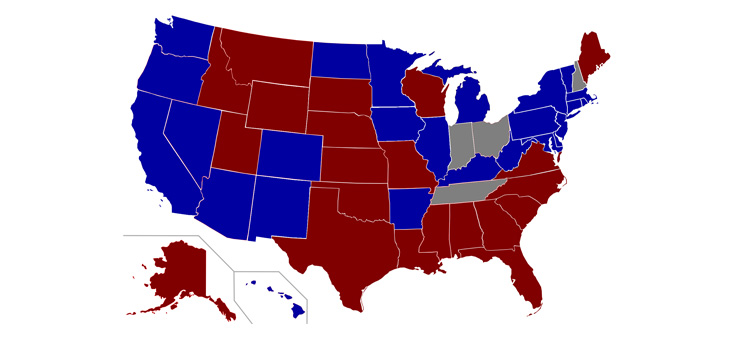
A new study from Athena Health and distributed by the Robert Wood Johnson Foundation reviewed data from 20, 000 physicians in the United States and found that physicians whose practices were based in states that haven’t expanded Medicaid were receiving higher rates of pay than those in states that did expand the entitlement program.
New Study: Doc Pay Disparities Tied to Certain States
1 min read Premium comments
Secondary
The report showed that primary care physicians (PCPs) and surgeons are collecting more in reimbursement since implementation of the Affordable Care Act (ACA), especially those in states that did not expand Medicaid. From 2013-14, PCPs in states that did not expand Medicaid experienced a 3.3% increase in reimbursement collections while for states that had expanded Medicaid, the increase was 3.0%. For surgeons, reimbursement collections rose 4.0% in non-expansion states and 2.0% in expansion states.
While millions of Americans, as a result of the Affordable Care Act, have received health insurance coverage, the number of physician office visits has not increased dramatically as a result. The number of surgical visits has increased only modestly, while the number of primary care visits has actually decreased.
The report came from Athena Health, a leading provider of cloud-based services for electronic health records (EHR), revenue cycle management and medical billing, patient engagement, care coordination, and population health management, as well as Epocrates and other point-of-care mobile apps—62, 000 health care providers in medical practices and health systems nationwide are in the Athena Health system.
Author
React:
Discussion
This is a fascinating development. In my practice we've seen similar outcomes with the revised protocol. The key differentiator seems to be patient selection criteria. Has anyone else noticed the correlation with BMI thresholds?
Great point. I'd push back slightly on the conclusion, the sample size in the cited study is too small to draw population-level inferences. That said, the directional signal is compelling and worth a larger RCT.
We implemented a similar approach last year. Early results are promising but we're still gathering 12-month follow-up data. Happy to share our protocol if anyone is interested.
Join the conversation
Orthopedic professionals are discussing this. Sign in and upgrade to read every comment and add your voice.