
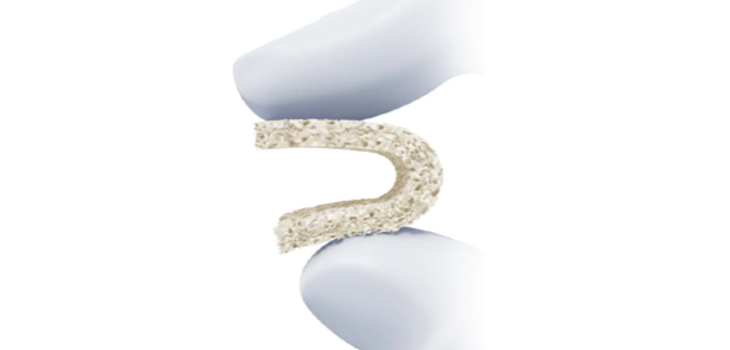
DePuy Synthes Trauma says it has launched Conform Flex, the only pre-hydrated demineralized cancellous bone tissue matrix for use in trauma-related extremity procedures for the foot and ankle, hand and wrists, including fusion, and for filling bone voids.
New Extremities Bone Matrix From DePuy Synthes
1 min read Premium comments
Secondary
The October 8, 2015 announcement was made at this year’s Orthopaedic Trauma Association Annual Meeting in San Diego.
The implant, according to the company, is both osteoconductive, providing a natural scaffold for new bone growth, and osteoinductive for stimulating new bone formation. It also resists migration after implantation, is readily absorbent and retains bone aspirate, blood and saline, and can be osteogenic when combined with bone marrow aspirate.
Available in both cubes and strips, the implant is also flexible and may be compressed up to 50% of its original size.
Packaging
The company said the implant is offered with Q-Pack technology, an ambient temperature packaging method “that enables the tissue form to come in a fully hydrated state, eliminating the rehydration step required in procedures using other implants of this kind.” The tissue form is ready for use immediately out of the package.
The Musculoskeletal Transplant Foundation (MTF) processes the material. The natural growth factors that give Conform Flex its osteoconductive properties and conformability are exposed, and pH is restored to a normal physiologic range allowing optimal cell viability and function. Processing and packaging are performed under controlled aseptic condition. ISO Class 4 certified clean rooms are used to ensure the finished tissue form passes USP <71> sterility tests.
DePuy Synthes Trauma is a division of DePuy Orthopaedics, Inc.
Author
React:
Discussion
This is a fascinating development. In my practice we've seen similar outcomes with the revised protocol. The key differentiator seems to be patient selection criteria. Has anyone else noticed the correlation with BMI thresholds?
Great point. I'd push back slightly on the conclusion, the sample size in the cited study is too small to draw population-level inferences. That said, the directional signal is compelling and worth a larger RCT.
We implemented a similar approach last year. Early results are promising but we're still gathering 12-month follow-up data. Happy to share our protocol if anyone is interested.
Join the conversation
Orthopedic professionals are discussing this. Sign in and upgrade to read every comment and add your voice.