
Three years ago Michael Bavlsik, M.D. suffered a crushed spine in a highway collision. The injury left him paralyzed but he did retain some movement in his arms. That fact, according to Durrie Bouscaren, writing for St. Louis Public Radio, made Bavlsik a candidate for nerve-transfer surgery.
Nerve Transfer Surgery Treats Paralysis
2 min read Premium comments
Secondary
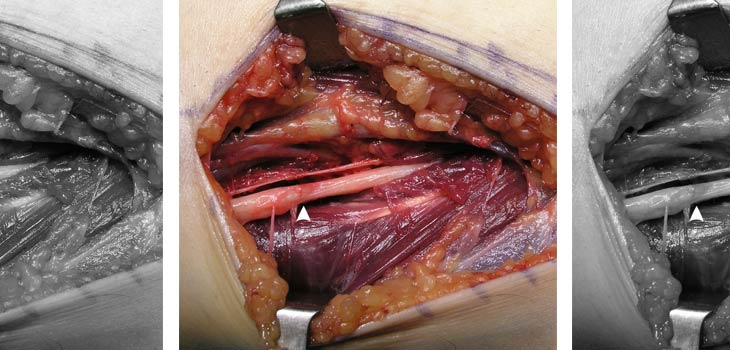
At Barnes Jewish Hospital, Ida Fox, M.D., a plastic and reconstructive surgeon at Washington University in St. Louis, took a healthy nerve from Bavlsik’s shoulder and, bypassing the spinal cord, rerouted it to his tricep.
She followed that with a second surgery in which she took a nerve in his upper arm and connected it to a nerve in his hand. The healthy nerves began to re-grow at a rate of one inch per month. It has now been a year since the surgery on the nerves ad Bavlsik has enjoyed continued improvement in the use of his wrists, elbows and the strength of his grip.
According to Bouscaren, since 2009, about a dozen people with spinal cord injuries have undergone nerve transfer surgery to improve hand and wrist function at Barnes Jewish Hospital. The vast majority of patients were able to regain significant use of their hands, arms or grip strength a year after the surgery.
“I tell patients it’s like untapped gold, ” Fox said. “There’s all this stuff that’s there that is below the level of spinal cord injury and is staying alive. I think, hopefully, once the nerve grows down to the new root and your brain starts talking to it that you’ll get some of the function that we saw is available there.”
According to the National Spinal Cord Injury Statistical Center, about 276, 000 Americans are living with a spinal cord injury. About half of those injuries are at the cervical level on the upper part of the spine, which often means a person cannot move their legs or hands, but may retain some movement in their shoulders and elbows.
Raj Rao, M.D., an orthopedic surgeon at George Washington University and spokesperson for the American Academy of Orthopaedic Surgeons, said that there are few options to help people with spinal cord injuries improve movement and functionality, and nerve-transfer is one of them. But most are work-arounds, and don’t treat the actual injury itself.
“Even if the treatment has the potential to work, it has to work in an area that’s developed so much scar tissue because of the original injury, ” Rao said. “There have been multiple things tried, including an injection of stem cells, but nothing is really proven to be effective in well-controlled studies.”
Furthermore, Rao said, people with spinal cord injuries at the C6 and C7 vertebras are often able to see increased functionality below the level of their injury without major interventions, so it can be a challenge to tease out which improvements are the results of a surgery, and which would have happened naturally.’
Fox agrees, saying that, “This is definitely a stop-gap measure. But anything we can do to improve quality of life right now, without needing a big electronic device or something fancy, mechanical, or a splint that gets in the way or is cumbersome, is really a wonderful gift to give.”
Author
React:
Discussion
This is a fascinating development. In my practice we've seen similar outcomes with the revised protocol. The key differentiator seems to be patient selection criteria. Has anyone else noticed the correlation with BMI thresholds?
Great point. I'd push back slightly on the conclusion, the sample size in the cited study is too small to draw population-level inferences. That said, the directional signal is compelling and worth a larger RCT.
We implemented a similar approach last year. Early results are promising but we're still gathering 12-month follow-up data. Happy to share our protocol if anyone is interested.
Join the conversation
Orthopedic professionals are discussing this. Sign in and upgrade to read every comment and add your voice.