
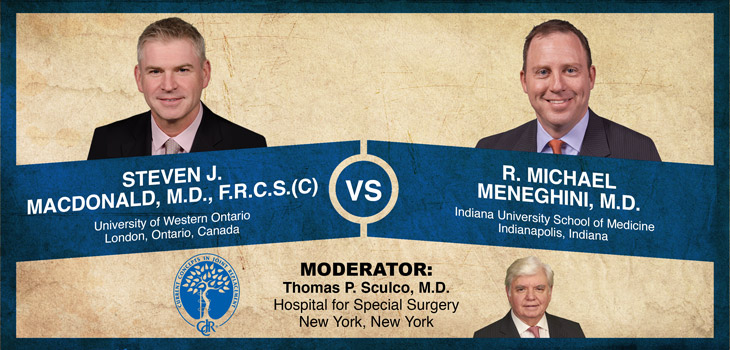
This week’s Orthopaedic Crossfire® debate was part of the 16th Annual Current Concepts in Joint Replacement® (CCJR) – Spring meeting, which took place in Las Vegas this past May. This week’s topic is “Femoral Head Materials: No Difference in Outcomes.” For the proposition is Steven J. MacDonald, M.D., F.R.C.S.(C), University of Western Ontario, London, Ontario, Canada. R. Michael Meneghini, M.D., Indiana University School of Medicine, Indianapolis, Indiana opposing. Moderating is Thomas P. Sculco, M.D., Hospital for Special Surgery, New York, New York.
MacDonald v Meneghini: Femoral Head Materials: No Difference in Outcomes
9 min read Premium comments
Great Debates
Dr. MacDonald: This debate is about whether we should be using a cobalt chrome head or a ceramic head. If you look at the bearing selection and where we are in 2015, it’s interesting. Six or seven years ago, hard-on-hard bearings, metal-metal, ceramic-ceramic were almost one-third of the U.S. market and a good portion of the global market too. Today, however, the vast majority of primary total hips are highly crosslinked polyethylene and the head mix is about 50% cobalt chrome, 50% ceramic.
So what about the femoral ball? What should we be doing there? The Australian Registry’s most recent report has a quarter of a million primary total hips in it which are broken down by type of bearing surface and basically the best performing bearing with the lowest 10-year cumulative revision rate remains cobalt chrome on highly crosslinked polyethylene at 4.3%.
Ceramic-on- highly crosslinked polyethylene data was similar at 4.6%. Those are the numbers from a big national registry database. We also learned from the Australian Registry that ceramic-on-ceramic larger heads did well. Also metal-on-metal smaller heads did well. Highly crosslinked polyethylene, there seems to be a little bit of a sweet spot with a 32mm head having the lowest cumulative revision rate. So the 32mm head is 3.8% and both the 28mm and 36mm are about 1% point higher.
The trends in Australia are very similar to what you see in the U.S. Decreased use of cobalt chrome, increasing use of ceramic. But not all ceramics are created equal. Really what we’re talking about is the Delta ceramic head. So why choose a Delta head over a cobalt chrome head? I’ve already explained there’s no evidence for decreased revision rate and there’s lots of registry data around the world and case reports showing the same thing. So you can’t claim a decreased revision rate using a Delta head. I think really there’s no evidence for decreased clinically relevant wear rates. Obviously, we don’t know what the 25-30-40 year experience will be, but after two decades, almost, of use…15-16 years of highly crosslinked polyethylene both are performing exceeding well.
One of the main issues is that the Delta ceramic head comes at a significant price premium. In my institution, it’s a $600 upcharge, and you might think that’s pretty cheap, that’s Canadian market, but that’s a 2.5 times upcharge over what it would cost for a cobalt chrome head. So why choose Delta over cobalt chrome?
One answer to that question is trying to minimize the risk of taper corrosion. This came to light with the Rush publication three years ago. Does a ceramic head decrease the risk of trunion corrosion? I would put it to you that in 2015 we have absolutely no idea quite frankly. Let’s be very clear regarding corrosion. It’s multi-factorial. Likely ball diameter, taper design, contact area, preparation of the taper, impact force. All of these things probably have somewhat of a mitigating role.
Delta ceramic is not the ultimate solution. Pseudotumors have been described with the Delta ceramic. Prosthetic head femoral fracture rate—quite frankly, it’s pretty uncommon with the current generation of ceramic heads. The Australian registry reporting 1 in 70, 000 Delta heads.
In summary, those choosing a Delta head…they don’t have clinical evidence of superiority, they are hoping for a lower corrosion rate and somehow accept the cost differential. I think those choosing a cobalt chrome head are probably just inherently more intelligent.
Dr. Meneghini: I think as we know ceramic and cobalt chrome femoral heads both have a long history of success and survivorship. There’s minimal difference between the two on wear rates, osteolysis, and survivorship. Paul Lachiewicz just reported at the Hip Society meeting a wear rate of 0.027 mm/year with cobalt chrome heads on highly crosslinked polyethylene. There are small osteolytic lesions but good wear rate at 10-14 years.
The Australian Registry data shows that highly crosslinked polyethylene with cobalt chrome and ceramic femoral heads are very, very similar. The 2012 Norwegian Registry Alumina ceramic 92.3%, and cobalt chrome, just slightly better at 94% survivorship at 8 years. No dramatic difference between the two.
Let’s talk about the trunion. Trunionosis has re-emerged as a failure mechanism in total hip arthroplasty. We’re still struggling to figure out the incidence. We’re still struggling to find out the etiology. Bearing friction torque’s an option. The mechanical stresses we know relate to it. It’s a mechanical phenomenon that starts in the taper geometry with implant stiffness, high offset stems and large heads all playing a role.
As Steve mentioned, it just came to light in JBJS-Am 2012 (Cooper et al.)—10 patients, 3 different manufacturers, and varying degrees of soft tissue necrosis. And all of us in our practices were seeing it to a certain degree. Then just recently Carli et al. (Hip Int 2015) decided to go look and see if they could cumulate the total incidence in the peer-reviewed literature and came up with 778 cases in 24 articles.
There was a correlation with large heads and small tapers, and universally the treatment was a conversion to a ceramic head and a polyethylene liner. That’s how you treat the problem and you’ll see that consistently. McGrory just reported on a consecutive series, one manufacturer, but a variety of stems, over 1, 000, with a 1.1% incidence of head-neck corrosion and associated with an adverse local tissue reaction (ALTR). Three patients had irreversible tissue damage. You can factor that into your cost benefit analysis. And the authors recommended ceramic heads. The other thing I would make you aware is that fretting corrosion is a time-dependent phenomenon. The longer those tapers are in contact, the greater chance it will occur as the years go by.
There is some biomechanical data to support the increased stresses on these tapers. It was published in 2006, out of the Harvard group…larger head diameter against highly crosslinked polyethylene. All transmit greater forces to the taper. We have similar work that we presented along the same lines.
Another biomechanical study (Schmidig, et al., J Arthroplasty 2010) showed that increased head size raises the frictional torque. So again, you’re transmitting those forces to the taper. I agree we don’t know the incidence yet, but it’s a phenomenon we should be concerned about. At least be aware of.
We have some retrieval data also supporting this. Journal of Arthroplasty, 2013, 36mm heads had greater fretting corrosion compared to 28mm cobalt chrome heads. So you’re seeing some similarities. It’s not that we haven’t narrowed it down completely…we’re getting closer to it…but there are some factors that we have to consider and I think most of us still use larger femoral heads when we can. So that factors into our bearing choice as well.
And then as Steven mentioned, the Steve Kurtz article looking at ceramic corrosion risk, there was less fretting corrosion in the ceramic heads compared to the cobalt chrome heads. It’s not a matter of argument at this point. We know ceramic corrodes less.
Ceramic head fracture…I think Steve gave up on that one…there’s no doubt the fracture risk is very minimal with the newer versions and the registry data supports that very clearly.
In summary, there’s no difference between ceramic and metal heads with respect to wear rates and osteolysis, and there’s currently no registry difference in survivorship between the ceramic and metal heads, at this current time. As we continue to follow it, and as people become more educated on that painful hip that they decide to dismiss and get out of their clinic…when we start to see that those patients may have an issue that we originally weren’t familiar with, this data may change over time.
Moderator Sculco: Steve, in your current practice, what percent of your femoral heads are ceramic and what percent are cobalt chrome? And what’s your selection criteria?
Dr. MacDonald: In our current practice, 98% of the time we’re using a cobalt chrome head. People in their 40s and 30s we use a Delta head.
Moderator Sculco: You’ve been doing joint replacement for many, many years, what’s your gut about corrosion?
Dr. MacDonald: I think there’s been two prime drivers—change from 28mm heads to 32-36mm and that does put increased stress on the taper. And there’s been subtle taper changes that haven’t been fully disclosed to maximize, if you will, the way a ceramic head fits. But I also think it’s a multitude of things, quite frankly, that have led to this. We’ve always seen corrosion. If anybody’s been a revision surgeon…we’ve always seen it. So it’s not new. The issue is we’re seeing reports of corrosion two years, three years, the reason driving the revision is the soft tissue reaction. That’s new. I certainly did not ever see that described until the last 2-3 years. I wouldn’t have seen that 5-10 years ago—never a case.
Moderator Sculco: So Michael, you use ceramic in everybody. Is that correct?
Dr. Meneghini: Yep.
Moderator Sculco: How do you justify that to your hospital administrators when, as Steve pointed out, the cost is so much greater?
Dr. Meneghini: Yeah, I actually feel very, very strongly about this. We have a gain sharing program where we share in the profitability of our cost savings measures and I still use ceramic heads because I believe it’s the right thing to do. I think that series from McGrory is a good sort of beginning—over 1, 000 hips and he followed them for a long time with about a 1% incidence. That’s not huge. But it’s something I don’t want to deal with, so if I have a choice and I can minimize 1% complications in my patients, I absolutely will do that. And I’ll justify it to my administrators that way.
Moderator Sculco: The cost will be considerably greater though for that little 1% potential problem. Don’t you think?
Dr. Meneghini: Yeah, can’t get away from it. Sometimes we have to spend money. I know nowadays we don’t want to spend any money, but at some point, you have to bear the cost of a good outcome. If any of you have been in surgery where the abductors are gone and you see the soft tissue destruction from a reaction, it’s pretty horrific and I think that’s what we want to avoid if we can.
Moderator Sculco: What do you do when you revise a patient who has corrosion? You get in there and there’s corrosion along the trunion, you have a low threshold for actually removing the stem? Do you just change the head?
Dr. Meneghini: In general, if we can keep the stem, then we will, but if the corrosion is really severe and the taper is badly damaged, we pull it.
Moderator Sculco: You pull it out. And what’s your go to head of choice at that point? Ceramic?
Dr. Meneghini: Ceramic, of course.
Moderator Sculco: What’s your thought on that, Steve? You’re going to go back in. There’s a little bit of damage on the trunion. It’s not very great. How do you handle that? You don’t think it’s bad enough to take the stem out.
Dr. MacDonald: I would leave the stem. Do a ceramic head with a titanium sleeve. Let’s face it. Taking out a cementless stem, it can go really well, and it can go really poorly. And the ones that go poorly, functionally they’re not quite exactly the same. We don’t know the long-term answer of the titanium sleeve on the Delta head, but that’s what I would do to get the best short-term patient outcome.
Moderator Sculco: Very good job.
Please visit www.CCJR.com to register for the 2015 CCJR Winter Meeting, December 9 – 12 in Orlando.
React:
Discussion
This is a fascinating development. In my practice we've seen similar outcomes with the revised protocol. The key differentiator seems to be patient selection criteria. Has anyone else noticed the correlation with BMI thresholds?
Great point. I'd push back slightly on the conclusion, the sample size in the cited study is too small to draw population-level inferences. That said, the directional signal is compelling and worth a larger RCT.
We implemented a similar approach last year. Early results are promising but we're still gathering 12-month follow-up data. Happy to share our protocol if anyone is interested.
Join the conversation
Orthopedic professionals are discussing this. Sign in and upgrade to read every comment and add your voice.