
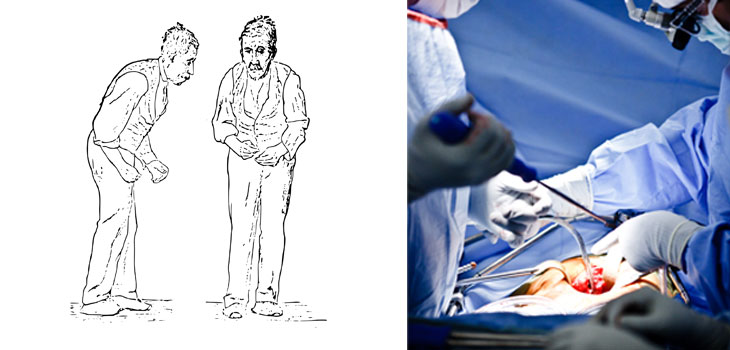
Researchers from New York and Israel have taken on an unusual topic…lumbar spine surgery in patients with Parkinson’s disease. The investigators, from Hadassah Hebrew University Medical Center in Jerusalem, and Beth Israel Medical Center and Hospital for Special Surgery (HSS) in New York City, found that Parkinson’s patients fared well after undergoing lumbar spine surgery, and experienced a decrease in pain.
Lumbar Spine Surgery in Parkinson’s Patients: Good Results
1 min read Premium comments
Secondary
According to the study, the team identified 96 patients who underwent lumbar spine surgery between 2002 and 2012. Of these, 72 had spinal stenosis, 17 experienced spondylolisthesis, and 7 suffered from coronal and/or sagittal deformity. The visual analog scale for back pain improved from 7.4 cm preoperatively to 1.8 cm postoperatively. The visual analog scale for lower-limb pain improved from 7.7 cm preoperatively to 2.3 cm postoperatively. The Oswestry Disability Index score dropped from 54.1 points to 17.7 points at the time of the latest follow-up.
Josh Schroeder, M.D., an orthopedic surgeon with Hadassah Hebrew University Medical Center, told OTW, “The study was prompted by several patients who suffered from Parkinson’s disease. We tried to locate existing data on the topic, but could not find any large study on Parkinson’s, despite this being a disease that affects 5% of the elderly population.”
“I was surprised to see that most patients do well after surgery. Sometimes less is more, and doing a smaller surgery might be better for the patient. Ours is the first large study on Parkinson’s patients, and it taught us to divide the patients into groups from mild to severe Parkinson’s disease.”
“In the future, a large prospective study is mandated, if possible to include neurodegenerative diseases such as muscular dystrophy and more. The important message is, ‘See the patient, tailor the procedure to the patient and understand that input from a neurologist is critical.’”
React:
Discussion
This is a fascinating development. In my practice we've seen similar outcomes with the revised protocol. The key differentiator seems to be patient selection criteria. Has anyone else noticed the correlation with BMI thresholds?
Great point. I'd push back slightly on the conclusion, the sample size in the cited study is too small to draw population-level inferences. That said, the directional signal is compelling and worth a larger RCT.
We implemented a similar approach last year. Early results are promising but we're still gathering 12-month follow-up data. Happy to share our protocol if anyone is interested.
Join the conversation
Orthopedic professionals are discussing this. Sign in and upgrade to read every comment and add your voice.