
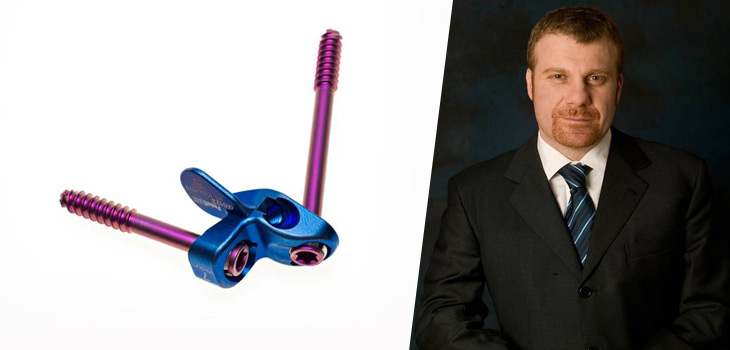
LinkSPINE has announced the first U.S. implantation of the FacetLINK HEMI. According to the October 9, 2015 news release, the titanium HEMI device is a low-profile plate that cross connects a Transfacet pedicle screw on the ipsilateral side of a Micro-Decompression to a Translaminar pedicle screw on the contralateral side. It is designed to provide rigid bilateral fixation through a tissue sparing, unilateral decompression approach.
LinkSPINE: First U.S. Implantation of FacetLINK HEMI
2 min read Premium comments
Secondary
Faheem Sandhu, M.D., professor of Neurosurgery and director of Spine Surgery at Medstar Georgetown Hospital, performed the first U.S. HEMI case at Medstar Southern Maryland Hospital in Clinton, Maryland. “As a neurosurgeon focused on minimally invasive spine surgery, I will often perform a microsurgical decompression through a unilateral approach and use the ‘crossover technique’ to decompress the contralateral recess, ” explained Dr. Sandhu. “This approach enables me to address bilateral symptoms through a small exposure and to keep the posterior ligamentous structures completely intact. The HEMI’s ability to secure robust bilateral fixation through this microsurgical decompression is an attractive feature to me. The patient is doing great in the early post-operative period.”
LinkSPINE President Massimo Calafiore stated, “The FacetLINK platform is designed to fit within the bounds of a surgeon’s preferred decompression exposure, requiring no additional dissection beyond what was planned for the decompression itself. The HEMI requires only two screws to secure a low profile one level construct versus four screws which are needed when using conventional pedicle screw instrumentation.”
As indicated in the news release, “The Facet-Link Stabilization Platform is intended to stabilize the spine as an aid to fusion through immobilization of the facet joints. The system is indicated for use with bone graft, at single or multiple levels, from L3 to S1 (inclusive). The platform is indicated for the treatment of spondylolisthesis, degenerative disc disease (DDD) as defined as back pain of discogenic origin as confirmed by radiographic studies, and degeneration of the facets with instability.”
Mr. Calafiore told OTW, “The HEMI device is a less invasive fixation implant that is designed for placement with a minimal amount of fluoro. Given its small size and low profile, the bilateral fixation the HEMI provides is impressive.”
“FacetLINK forms the foundation of LinkSPINE’s ‘Midline Choice’ implant platform. Additional products are under development which will integrate with FacetLINK to provide intra-operative flexibility to choose a less invasive stabilization construct based upon patient pathology, anatomy, and surgeon preference. We will continue to focus upon patient outcomes and surgeon feedback to guide our product development efforts.”
A company spokesperson stated: “We are grateful and extremely honored to be chosen as a winner in the minimally invasive spine surgery category for the 2015 Orthopedics This Week Spine Technology Awards. Our focus has been and will remain upon the patient, and continuing to develop simple, elegant solutions that reduce surgical morbidity and improve outcomes. We are excited about the opportunity to continue innovating toward a comprehensive “Midline Choice” platform that offers the surgeon a robust set of implant choices that can be tailored to various anatomical and pathological scenarios.
React:
Discussion
This is a fascinating development. In my practice we've seen similar outcomes with the revised protocol. The key differentiator seems to be patient selection criteria. Has anyone else noticed the correlation with BMI thresholds?
Great point. I'd push back slightly on the conclusion, the sample size in the cited study is too small to draw population-level inferences. That said, the directional signal is compelling and worth a larger RCT.
We implemented a similar approach last year. Early results are promising but we're still gathering 12-month follow-up data. Happy to share our protocol if anyone is interested.
Join the conversation
Orthopedic professionals are discussing this. Sign in and upgrade to read every comment and add your voice.