
K2M Group Holdings is getting into the 3D printing business using titanium powder.
K2M Jumps Into 3D Printing
1 min read Premium comments
Secondary
The company introduced Lamellar Titanium Technology at the 2015 North American Spine Society (NASS) Annual Meeting in Chicago.
Titanium Powder
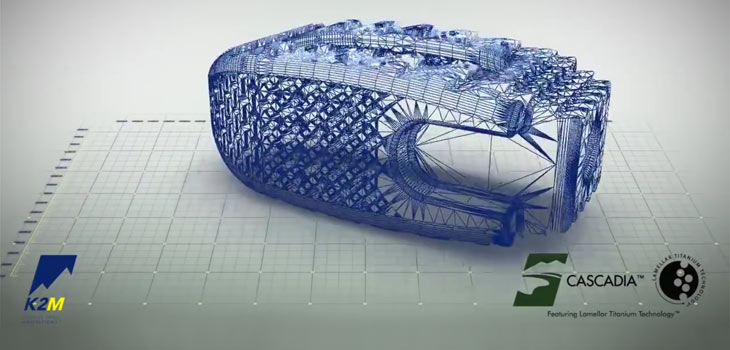
The technology, according to the company, starts with a titanium powder where the implants are grown through the selective application of a high-energy laser beam, allowing for the incorporation of both a porosity and surface roughness that pre-clinical data have associated with bone growth activity.
The first products to use the technology are the Cascadia AN and TL Interbody Systems. The company recently received 510(k) clearance from the FDA and a CE Mark in Europe for those systems.
Tom Morrison, M.D., a neurosurgeon at Polaris Spine & Neurosurgery Center in Atlanta, Georgia, said this technology is an, “innovative alternative” to many traditionally manufactured PEEK and titanium designs in the interbody space. He added that the Cascadia platform provides a balance of roughness and porosity that may allow the bone to grow into the implant.
Technical Specifications
The company says the technology incorporates titanium with a surface roughness of 3–5 microns that is designed to allow for direct bony ongrowth. “This surface roughness has been shown, in peer-reviewed research and pre-clinical data, to increase osteoblastic activity compared to smooth titanium and other biomaterials, such as PEEK.”
Interconnected pores in the diametrical range of 300–700 microns, according to research cited by the company, are ideal for allowing bone ingrowth through porous biomaterials. K2M’s technology incorporates 500 micron diameter pores that run through the walls of the implant, forming continuous channels from endplate to endplate to serve as a conduit for bony integration.
The Cascadia systems, according to the company, have been designed with radiographic imaging quality in mind. The porosity inherent with the technology in conjunction with the proprietary design of the Cascadia interbodies “results in an approximately 70% porosity overall, and therefore a decreased radiographic signature when compared to equivalent traditional nonporous titanium designs.”
Eric Major, K2M’s president and CEO, called it a “breakthrough technology.”
Author
React:
Discussion
This is a fascinating development. In my practice we've seen similar outcomes with the revised protocol. The key differentiator seems to be patient selection criteria. Has anyone else noticed the correlation with BMI thresholds?
Great point. I'd push back slightly on the conclusion, the sample size in the cited study is too small to draw population-level inferences. That said, the directional signal is compelling and worth a larger RCT.
We implemented a similar approach last year. Early results are promising but we're still gathering 12-month follow-up data. Happy to share our protocol if anyone is interested.
Join the conversation
Orthopedic professionals are discussing this. Sign in and upgrade to read every comment and add your voice.