
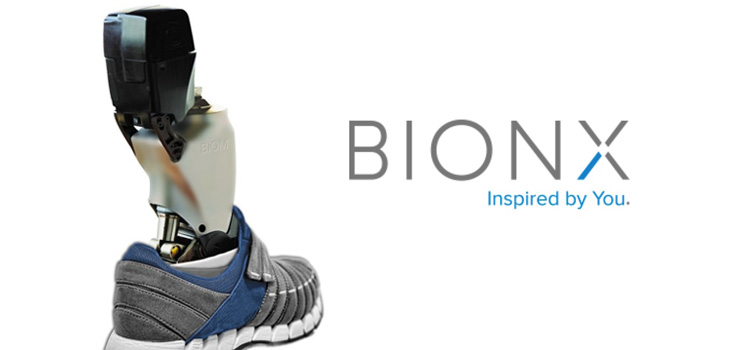
The bionic prosthetic company iWalk (aka BiOM) has had a makeover. The company has re-launched itself as BionX Medical Technologies, Inc. and is sporting a new logo. According to the company, this re-launch also reflects company milestones, including the addition of an executive team, product enhancements, international commercial expansion and ongoing support from reimbursement authorities such as the U.S. Department of Veterans Affairs and Workers’ Compensation payers.
iWalk Re-Launched as BionX Medical Technologies
1 min read Premium comments
Secondary
“Our company was founded to revolutionize the prosthetic device industry by providing products, based on our bionic platform, that enable patients to have more freedom in their lives. Over the last year, we have made significant progress towards achieving this goal, having fortified our corporate organization, disciplined our commercial execution and continually expanded our IP portfolio and product pipeline, ” said company President and CEO Dr. Charles S. Carignan in the September 28, 2015 news release. “Our new name helps communicate our commitment to offering bionic solutions that restore normalized limb function and improve quality of life. We are continually inspired by our patients who strive to achieve their greatest potential.”
As indicated in the news release, “The BiOM Ankle, the company’s flagship product, is the only lower-limb prosthesis with powered propulsion for enhanced mobility. Only the BiOM Ankle provides power that emulates lost muscle function, control that mimics normal ankle movement and stability that automatically adjusts to any surface.”
Dr. Carignan told OTW, “In a year, we expect to have both broader payer coverage for the BiOM in the U.S. as well as an expanded footprint in Europe. We should also be in a limited launch phase for a new generation BiOM by the end of 2016.”
“We have completed a clinical feasibility study on a powered ankle foot orthosis device that would be the first orthotic for patients with drop foot and lower leg weakness with the same powered propulsion system as our current prosthetic ankle. We will begin work on its commercial development with the eye to launching the device in early 2018.”
React:
Discussion
This is a fascinating development. In my practice we've seen similar outcomes with the revised protocol. The key differentiator seems to be patient selection criteria. Has anyone else noticed the correlation with BMI thresholds?
Great point. I'd push back slightly on the conclusion, the sample size in the cited study is too small to draw population-level inferences. That said, the directional signal is compelling and worth a larger RCT.
We implemented a similar approach last year. Early results are promising but we're still gathering 12-month follow-up data. Happy to share our protocol if anyone is interested.
Join the conversation
Orthopedic professionals are discussing this. Sign in and upgrade to read every comment and add your voice.