
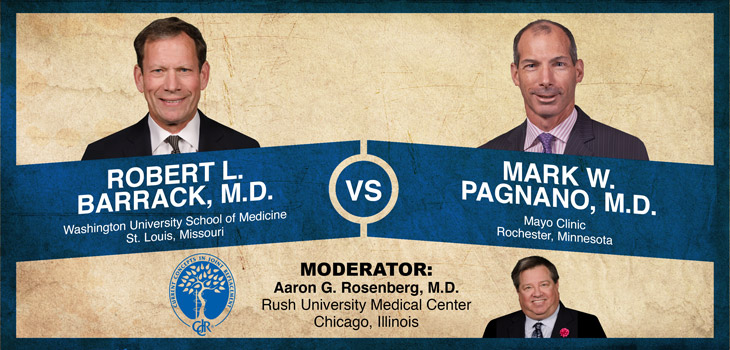
This week’s Orthopaedic Crossfire® debate was part of the 16th Annual Current Concepts in Joint Replacement® (CCJR) – Spring meeting, which took place in Las Vegas this past May. This week’s topic is “Patient Specific Cutting Blocks: Of Unproven Value.” For the proposition is Robert L. Barrack, M.D., Washington University School of Medicine, St. Louis, Missouri. Mark W. Pagnano, M.D., Mayo Clinic, Rochester, Minnesota opposing. Moderating is Aaron G. Rosenberg, M.D., Rush University Medical Center, Chicago, Illinois.
Barrack v Pagnano: Patient Specific Cutting Blocks: Of Unproven Value
8 min read Premium comments
Great Debates
Dr. Barrack: I’m going to espouse a point of view that these are of unproven value and I thought they would work, that’s why I did 200-300 of them. I’ll share my experience with you. Variability in component alignment is a major issue in total knee replacement. In the short-term such variability can lead to symptoms and long-term it can lead to failure. After a decade of clinical use, most of us have decided that navigation really doesn’t have a major impact. It never really penetrated the American market more than 3-5%. In the last 5-6 years, Patient-Specific Instrumentation (PSI), where we’re using MRI or CT to generate a model of every patient’s lower limb to produce the patient’s specific implants, have become available.
All of the existing devices use a neutral mechanical alignment with a zero degree hip-knee-ankle axis and the implants are perpendicular to the axis. Generally, parallel to the epicondylar axis. As these are the goals, it is important to ask these questions: Do these devices increase accuracy and minimize outliers? Do they increase efficiency and lower operative time and cost? Do they improve clinical outcome? We’ve done studies that we’ve published on all three of these issues: OR efficiency, radiographic accuracy, and patient satisfaction and function.
So we used an OR database to determine the total tourniquet time and total time in the room between cases with the PSI versus standard and every step in instrument processing was timed utilizing industrial efficiency methodology. These times were actually converted to the cost of the materials, personnel and a fixed overhead. Certainly there are fewer instruments and the OR crew liked it. The surgeons liked it. I liked it. We used four fewer instrument trays, but in a large center like ours, the actual savings to the hospital was surprising low—about $25 per case in wages and consumables. There was slightly lower OR time and turn-over time that translated into $300 of savings. So it’s about $320 per case saved by the hospital. But if you looked at the total cost, the guide itself cost almost $1, 000, the MRI cost about $1, 000, so the cost to the system was $2, 000. So the personnel liked it; the OR staff liked it, but if you can’t prove a clinical benefit in this day and age, particularly with bundled payments, you’re not going to be able to prove some cost savings unless there is a clinical advantage.
So we looked at radiographic results. We used the same CR knee—cruciate retaining knee—in all cases. We measured coronal alignment with CT “scout” methodology, which is very accurate, and we had a blinded observer measure all the x-rays. We looked at all the standard measurements of femorotibial angle, hip/knee/ankle axis and the zone of the mechanical axis. We found no difference in incidences of radiographic outliers. We achieved a target about 80% of the time with both methods. PSI really didn’t help us avoid outliers.
What about the major issue? Does it improve patient satisfaction and function? In a recent publication, we reported on 200 patients, 100 of each instrumentation methodology, that were carefully examined pre-op and post-op with all patient reported outcome measurements. We found no clinical difference in PSI versus standard instrumentation. Patients did not perceive any improvement in their results.
So why do current generation PSI, with a neutral mechanical alignment target, not alter results? There are a number of potential reasons. There are a number of sources of error in PSI that may actually be more than standard instrumentation. Chris Peters from Utah found that he had to make adjustments 2-3 times per case. Secondly, we have data to show that the cut plans, when you take an image of a patient that’s supine, non-weight bearing, with the hip and knee flexed, I don’t believe they’re accurate. And I think aiming for the same alignment and rotation is changing the axis of rotation in many patients.
We generated cut plans with weight-bearing images using EOS and found that the images obtained when you generate a plan with a weight-bearing patient and correct for rotation were dramatically different than the cut plans that were generated from an MRI with the patient supine and the hip and knee flexed.
Which is right? I would bet on the one with the patient weight-bearing and corrected for rotation.
In summary, we adopted PSI and used it in 200-300 cases hoping that it would improve the results of knee replacement, but it did not.
Dr. Pagnano: I’d like to review my approach to patient-specific instruments and look at CT-based solutions in that arena.
I think as surgeons we share some common goals in knee replacement. We want these knees to be reliable, durable and we want the operation to be safe as we seek to alleviate pain and improve function for our patients. There are many techniques that have been espoused over the past decade on how to get improvements. Computer-assisted surgery is something that Dr. Barrack and I would agree on. Computer-assisted surgery has no proven clinical benefits in knee replacement. Much of the initial enthusiasm for computer navigation has waned. It has proven to be cumbersome, time consuming, and expensive.
Patient-specific instrumentation was introduced with the idea that we might be able to harness some of the accuracy gains of computer navigation and take advantage of marked advances in 3-dimensional reconstruction techniques. To Dr. Barrack’s points, to date we haven’t harnessed all of these advantages in the patient specific instrumentation, but it remains within the realm of what is possible. One of the benefits is you move the computer part out of the operating room. There is the opportunity to save operating room time, operating room resources, and I think, importantly, save some of the surgeon’s mental energy to focus on soft tissue balancing at the time of surgery.
There are multiple vendors of PSI. There are multiple differences between the different types of instruments that are available. The alignment goals now are all based on the mechanical axis. Imaging modalities are CT, MR or MR+, hip/knee/ankle x-ray. You can use pin guides or integrated cutting guides. I think what’s important also is the degree of surgeon input into the pre-op planning processes. My personal preference when I utilize PSI is to use CT imaging. I think you get the best data with that for a 3-dimensional model. You get more data, a higher level of detail, better resolution based on the image acquisition matrix of CT versus MRI. I want surgeon involvement in the pre-op planning throughout the whole process. I think the surgeon should be involved in all aspects of the planning process. Review, approve, change, redesign. If you don’t do that, if you just rely on generic, average solution, you can expect generic, average results.
I want cutting guides, not just pin guides, and I prefer an integrated metal cutting slot to harness the accuracy of the cutting. The blocks can get multiple points of contact with the patient’s bone, so why give up that good fit and just rely on two pins when it’s time to make the cut. And if you cut through metal, not just plastic—there’s a long track record of cutting through metal slots in orthopedic applications—I think you’re going to get the best accuracy and it’s going to be the most efficient way to accomplish that.
With the CT-based blocks, at least, the real world accuracy based off of the plan is pretty good. We can argue whether the plan that’s generated is right, wrong or indifferent. The real world accuracy is quite reasonable. The cartilage mapping for the CT-based imaging is certainly very importantand there is proprietary segmentation software that is available from a couple of different manufacturers.
So who wins? I think that depends on where you stand in the healthcare system. The patient can win in certain circumstances because they can get reliable surgery with predictable outcomes. The surgeon can win because there is some time advantage. This time advantage is particularly pertinent to lower and middle volume surgeons in general hospital settings. The hospital can get increased productivity and decreased stress among their OR staff. For some of the payers at least they have been able to demonstrate reduced total care costs. Again, particularly when you’re dealing with low and middle volume surgeons and hospitals.
In conclusion, I think PSI allows us to move the computer part out of the operating room, save operating room time and resources, save our mental energy during surgery to focus on soft tissue balancing.
Moderator Rosenberg: Robert, your main complaint about PSI is that it’s not cost effective, and you see no difference in alignment or clinical status. If it were to be demonstrated to be cost effective, would you be more interested in using it on a regular basis?
Dr. Barrack: I used it. I didn’t undertake a study hoping it wouldn’t work. I wouldn’t put 200 patients through that. I hoped it would work. It just doesn’t. It has to be more than cost neutral because the time it takes for a patient to have a CT scan, for your office to schedule the scan, then for you to go online and manipulate the scan, is longer than it takes to do a total knee with standard instruments. And there’s the radiation exposure of CT. Go to any radiology meeting, it’s a huge issue…x-ray exposure of CT is all over their literature. So it has to be more than cost neutral. In the current environment, you have to prove improved outcome and patient satisfaction, otherwise how do you justify the additional time and expense of the CT scan and the work you do to read it?
Moderator Rosenberg: So at the end of the day, my sense of it is that it’s a wash in many respects. The benefits and the risks of it sort of balance out and it accomplishes some of what Mark has said.
Dr. Pagnano: It’s dependent on doing what Robert did which is using standard radiographic or EOS imaging for generating 3-dimensional models based off of plain x-rays. You lower the cost, lower the barrier to entry, and I think, then, it’s a little more applicable widely.
Dr. Barrack: I think the million dollar question in knee surgery is whether we can improve overall clinical results and get rid of dissatisfied patients by individualizing how we align the components. If we saw their relative rotation of the tibia and femur and we customized the alignment and rotation of the components, then you use this technology . But to use this technology to align everybody the same, I don’t think you’re going to see a difference in clinical results.
Moderator Rosenberg: Gentlemen, thank you very much for your participation.
Please visit www.CCJR.com to register for the 2015 CCJR Winter Meeting, December 9 – 12 in Orlando.
Author
React:
Discussion
This is a fascinating development. In my practice we've seen similar outcomes with the revised protocol. The key differentiator seems to be patient selection criteria. Has anyone else noticed the correlation with BMI thresholds?
Great point. I'd push back slightly on the conclusion, the sample size in the cited study is too small to draw population-level inferences. That said, the directional signal is compelling and worth a larger RCT.
We implemented a similar approach last year. Early results are promising but we're still gathering 12-month follow-up data. Happy to share our protocol if anyone is interested.
Join the conversation
Orthopedic professionals are discussing this. Sign in and upgrade to read every comment and add your voice.