
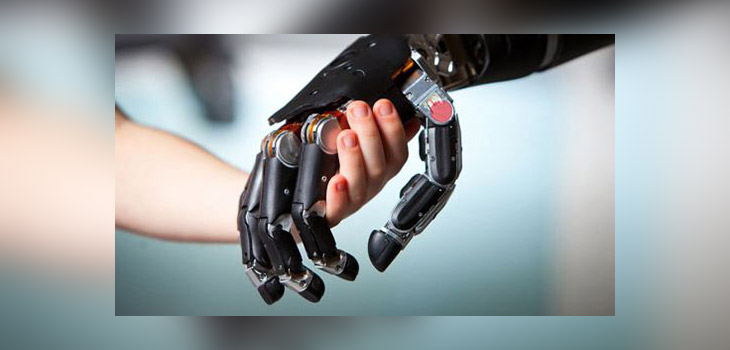
Honor Whitman, a reporter for Medical News Today, writes that a young paralyzed man has become the first person to regain what she reported to be “a near natural sense of touch” through a robotic hand that was connected directly into his brain.
Robotic Hand Wired to Brain Feels Touch
1 min read Premium comments
Secondary
Wires connected the robotic hand to electrodes that had been implanted into the area of the brain responsible for sensation—as well as to the brain region responsible for body movement. When researchers from the Defense Advanced Research Projects Agency (DARPA) touched the fingers of the robotic hand the young man was able, with almost total accuracy, to say which finger had been touched.

Whitman quoted Justin Sanchez, program manager at DARPA, who said, “At one point, instead of pressing one finger, the team decided to press two without telling him. He responded in jest asking whether somebody was trying to play a trick on him. That is when we knew that the feelings he was perceiving through the robotic hand were near-natural.”
Scientists at the Applied Physics Laboratory at Johns Hopkins University in Baltimore, Maryland, created the robotic hand while working under the Department of Defense program called the “Revolutionizing Prosthetic Program.”
Author
React:
Discussion
This is a fascinating development. In my practice we've seen similar outcomes with the revised protocol. The key differentiator seems to be patient selection criteria. Has anyone else noticed the correlation with BMI thresholds?
Great point. I'd push back slightly on the conclusion, the sample size in the cited study is too small to draw population-level inferences. That said, the directional signal is compelling and worth a larger RCT.
We implemented a similar approach last year. Early results are promising but we're still gathering 12-month follow-up data. Happy to share our protocol if anyone is interested.
Join the conversation
Orthopedic professionals are discussing this. Sign in and upgrade to read every comment and add your voice.