
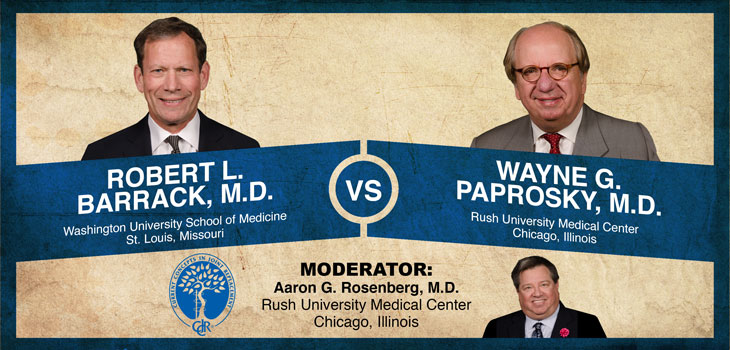
This week’s Orthopaedic Crossfire® debate was part of the 16th Annual Current Concepts in Joint Replacement® (CCJR) – Spring meeting, which took place in Las Vegas this past May. This week’s topic is “Patella Resurfacing: Rarely, if Ever Necessary.” For the proposition is Robert L. Barrack, M.D., Washington University School of Medicine, St. Louis, Missouri. Wayne G. Paprosky, M.D., Rush University Medical Center, Chicago, Illinois opposes the statement. Moderating is Aaron G. Rosenberg, M.D., Rush University Medical Center, Chicago, Illinois.
Patella Resurfacing: Rarely, if Ever Necessary
8 min read Premium comments
Great Debates
Dr. Barrack: Now legendary American football coach—Woody Hays for the younger people in the audience—said that three things can happen when you pass the ball and two of them are bad. That’s why he always ran the ball. In total knees there’s a corollary with that. There are about five things that can happen when you resurface a patella and four of them are bad. You can over resect, under resect, resect obliquely, you can disrupt the blood supply and the sequelae of all these are serious problems. But the people who resurface patellas will say, ‘Well, it’s pretty rare, it doesn’t happen very often.’ I would take issue with that and I have data that I’ll show you as to why I do.
One of our leading centers with high volume joint surgeons (Berend, et al, CORR 2001) looked at their patellas 2, 3, 4 years after surgery and they found a high percentage of them didn’t look so good on x-ray—4.2% failures that they classified as either collapsed, fragmentation or lateral subluxation at an average follow-up of only 5.5 years. Now, it makes sense if you look at an x-ray and you see fragmentation or any of these phenomena, that in a 10- to 12-year period you know this is just not a good situation.
So the question is, at a referral center what are the problems that we’re seeing? There are 10, 000 or 20, 000 total knees with unresurfaced patellas and a fewer number with resurfaced patellas. Which ones are causing the problems? Over a course of a year we studied how many patients were coming in with anterior knee pain and were they mostly resurfaced or unresurfaced. We looked at these follow-ups and we had 46 cases. Three-fourths of them actually had been resurfaced. Three times as many problems were occurring with resurfaced patellas.
We saw early loosening, patella revision…this is a problem there’s no solution for. Fragmented patella, loose component. What do you do for that? A whole extensor mechanism allograft? Many of these patients can still fully extend their knee. They’re a little weak. They’re frequently painful. But you just tell them to live with it. Fragmented loose patella. AVN of a patella. If you cut a little too thin, you do a lateral release, they’re painful. You get a bone scan, it’s very hot. There’s no solution to this problem as well. Latent stress fractures. Lateral facet pain is very common. If you leave any overhanging bone and the extensor mechanism is not well balanced, this causes pain.
So there are a lot of advantages to not resurfacing the patella. It’s faster, it’s less expensive. I can guarantee you as we shift more towards uncemented total knees; people are not going to pay the extra expense because it’s just not worth it. Mainly there’s a lower risk of major complications and as symptoms develop you have more salvage options. So a small percentage of patients are going to have symptoms in the front of their knee, whether or not you resurface the patella. But which retains more options, which has more serious complications? So the major determinant of the clinical result and the presence of anterior knee pain is a surgical technique and the component design, not whether or not you resurface the patella. So is it really necessary? I occasionally do it for a deformed mal-tracking patella, severe rheumatoid, but for the vast majority, it’s simply not necessary.
Dr. Paprosky: I’m obviously on the other side of this. Robert’s in St. Louis and that data’s mostly from St. Louis. Patella components don’t get loose. Anterior knee pain is markedly reduced with the new designs. If not, don’t blame the patella. Why do you think the patella? AVN, I haven’t seen one in a long time. Modern patellofemoral articulations have changed. External rotation of the component has been a game changer and it doesn’t take long to do it—maybe 60 seconds.
But patella resurfacing really is like food, cars and sports…it depends on where you live. If you live in Sweden; if you live in Chicago where we happen to resurface the patella. They don’t resurface the patella in Asia. We resurface in Chicago. I don’t use chopsticks to eat and if you work where I work and you drive the kind of car they have in Germany where they selectively resurface, they’re going to selectively steal your car in Chicago.
So what are the advantages? When looking at a 2-year study (Schroeder-Boersch H, et al, Arch Orthop Trauma Surg, 1998), 40 randomized patients, within 24 months the advantage of patella resurfacing could be seen according to the Knee Society score. We see superior functional results.
When we looked at expected value decision, the expected value refers to the predicted consequences of a decision, and we found in this particular series from 2008 (Helmy et al., CORR), anterior knee pain with a resurfaced patella was 12% compared with 26% without the patella. Jay Parvizi’s series (CORR 2005) looked at a meta-analysis comparing with and without resurfacing the patella, paying particular attention to patient satisfaction. This randomized clinical trial relevant to patellar resurfacing was done over a period of time, looking at 14 articles, and found that secondary resurfacing for anterior knee pain was needed in 8.7% of non-resurfaced patients. When we looked at it, secondary resurfacing is required in this series for 1 out of 10 patients.
When we look at more articles including Robert’s from 2001, we find that the summary for incidence of anterior knee pain for resurfaced patella was 13%, non-resurfaced from this series was 24%. Even in Robert’s series there was some anterior knee pain. When we look at incidence of revisions and re-operations, it’s 3% versus 8% for the non-resurfaced patella. When we look at incidence of revision of the patellar component, and there’s no revision in the non-resurfaced because it wasn’t an operation, it’s 1%. Incidence of re-operation for mal-tracking is equal. Incidence of patella fracture—okay, a little bit higher in resurfaced patellas—so that is going to occur.
Proper technique and modern total knee designs, which in my opinion is a game changer. I would agree with a lot of what Robert said if this would have been before rotation of the components, the old box-like IB series without rights and lefts—that was a different story. I used to do that. I used to leave many of them unresurfaced, but I’ve kind of evolved. So I say resurface the patella routinely to reduce incidences of re-operation, with proper technique in measuring and cutting the patella, proper orientation, there is little downfall nowadays. Given all the evidence, why would you want to make a choice? Just go ahead and resurface the patella. Why not finish the job? It’s like saying, ‘Well, the house is unfinished, but at least it lets more light in, so why finish it.’ I will give Robert one concession. The Cardinals are better than the Cubs, but that still doesn’t mean we’re going to not resurface the patella.
Dr. Barrack: I think there are lies, damn lies, and statistics. When you say patella resurfacing was required in 6%, 8%, 10% of the cases, it was just an easy thing to do so people did it. In fact, if you resurface the patella you have an equal amount of pain but you just tell patients to live with it because there isn’t an easy bailout procedure. If you hold the line and resist the easy option of just resurfacing an unresurfaced patella, you’re re-operation rate will be much lower and your results will be the same.
As far as anterior knee pain, again these are pooled data. When you showed the PFC Sigma, the AMK, you alluded to old designs and how you didn’t resurface the patella in those older designs. Well, you shouldn’t quote statistics from those older designs because with the newer techniques and the newer designs with extended grooves and a smoother, more congruent surface, you simply don’t need to resurface the patella. And a complication rate in your hands and high volume surgeons’ hands may be lower, but in the community that’s the last part of the case and it frequently does lead to complications.
Dr. Paprosky: With the older designs I found that you had more incidences of avascular necrosis because we were doing lateral releases and we didn’t have rights and lefts. Boxy designs like I alluded to. We didn’t know anything about rotation until 6-7 years ago. As those things have changed and we have better designs, it’s much easier to get the operation done. We balance the flexion extension gaps better with a greater variety of sizes, and I’m commenting as a PS surgeon. Because of what has evolved with the components, I think it’s much, much easier now to do it…the instruments…you can plane down the patella without doing lateral releases. It’s a much easier operation to get right.
Dr. Barrack: A key thing, Wayne, though is the data you were quoting of the increased incidence of anterior knee pain was largely with those older designs. So with the never designs and the newer techniques, you’ll find that you really don’t need to do it.
Moderator Rosenberg: It seems to me that in every other joint, metal and plastic resurfacing both sides of the joint has led to generally better results than metal and cartilage or metal and damaged cartilage. Why would the knee cap be different than the hip joint where we pretty well demonstrated that a total hip replacement that is replacing both sides of the articulation seems to yield a higher percentage of good results?
Dr. Barrack: You know the patella is a sesamoid bone. The nerve endings aren’t in cartilage; it’s a matter of getting the soft tissue balanced because if you’re not balanced and you have excessive forces, you get pain from the excessive tension in the soft tissue. But that’s going to be the case whether or not you resurface the patella. Having a piece of plastic there is not going to keep you from having pain from that overhanging facet that’s putting tension on the tissues. And you have to be careful about the statistics, but certainly if you look at registries, it’s very implant-specific. The implant you use in the Swedish registry has a lower revision rate when it’s not resurfaced. So using pooled data isn’t particularly useful to me because I’m only interested in results with the components I use and I haven’t seen a higher incidence of anterior knee pain. Certainly not re-operation.
Moderator Rosenberg: Thank you very much for a lively debate.
Please visit www.CCJR.com to register for the 2015 CCJR Winter Meeting, December 9 – 12 in Orlando.
React:
Discussion
This is a fascinating development. In my practice we've seen similar outcomes with the revised protocol. The key differentiator seems to be patient selection criteria. Has anyone else noticed the correlation with BMI thresholds?
Great point. I'd push back slightly on the conclusion, the sample size in the cited study is too small to draw population-level inferences. That said, the directional signal is compelling and worth a larger RCT.
We implemented a similar approach last year. Early results are promising but we're still gathering 12-month follow-up data. Happy to share our protocol if anyone is interested.
Join the conversation
Orthopedic professionals are discussing this. Sign in and upgrade to read every comment and add your voice.