
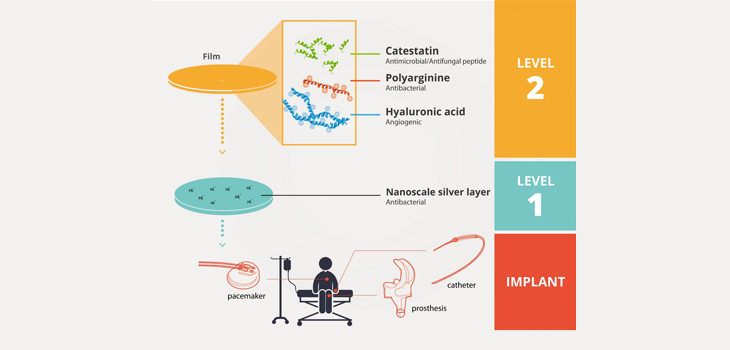
Researchers from Inserm/Strasbourg University in France have a new way of tackling infections. The team, housed at Unit 1121 “Biomaterials and Bio-engineering, ” has created a nearly invisible biofilm with antimicrobial, antifungal and anti-inflammatory properties. It may be used to cover titanium implants, and to prevent or control post-operative infections.
New Biofilm Has Antimicrobial, Antifungal, Anti-Inflammatory Properties
2 min read Premium comments
Secondary
According to the September 21, 2015 news release, “…researchers have used a combination of two substances: polyarginine (PAR) and hyaluronic acid (HA), to develop and create a film that is made of several layers. As arginine is metabolised by immune cells to fight pathogens, it has been used to communicate with the immune system to obtain the desired anti-inflammatory effect. Hyaluronic acid, a natural component of the body, was also chosen for its biocompatibility and inhibiting effect on bacterial growth.”
“The film is also unique due to the fact that it embeds natural antimicrobial peptides, in particular catestatin, to prevent possible infection around the implant…. As well as having a significant antimicrobial role, these peptides are not toxic to the body that they are secreted into. They are capable of killing bacteria by creating holes in their cellular wall and preventing any counter-attack on their side.”
“On the one hand, researchers demonstrate, through contact with human blood, that the presence of the film on the implant suppresses the activation of inflammatory markers normally produced by immune cells in response to the implant. Moreover, the film inhibits the growth and long-term proliferation of staphylococcal bacteria (Staphylococcus aureus), yeast strains (Candida albicans) or fungi (Aspegillus fumigatus) that frequently cause implant-related infection.”
Philippe Lavalle, Ph.D., research director at Inserm, told OTW, “Our lab has worked on surface coatings for several years. During discussions with surgeons from Strasbourg Hospital (in particular from the intensive care unit), it appears that nosocomial infections related to catheters, cardiac valves…are increasing and lead most of the time to dramatic issues for patients who are in intensive care units. So, we decided to focus a large part of our studies on the design of new coatings for medical devices with antimicrobial properties against the most common pathogens related to nosocomial infections. We decided to use polyarginine as one component of the reservoir used for antimicrobial agents, like catestatin, an antimicrobial peptide. The good surprise was that Polyarginine by itself appeared to act strongly as an antimicrobial against the bacteria S. aureus.”
“We can easily play with the components to increase the doses of antimicrobial agents, the delay of efficiency or the release profile. Moreover, our coating acts as a platform and we can also include some growth factors to obtain for example a reservoir of bone morphogenic proteins on the surface of the implant to promote bone regeneration.”
“We demonstrated the proof of concept and now we need to check its efficiency on animal models. Moreover, we believe we can again improve the system, as our very recent studies led to an upgraded version of the coating. Finally, although we would like to get a final product to market soon, because all of the components are natural or FDA approved, this will take some time.”
React:
Discussion
This is a fascinating development. In my practice we've seen similar outcomes with the revised protocol. The key differentiator seems to be patient selection criteria. Has anyone else noticed the correlation with BMI thresholds?
Great point. I'd push back slightly on the conclusion, the sample size in the cited study is too small to draw population-level inferences. That said, the directional signal is compelling and worth a larger RCT.
We implemented a similar approach last year. Early results are promising but we're still gathering 12-month follow-up data. Happy to share our protocol if anyone is interested.
Join the conversation
Orthopedic professionals are discussing this. Sign in and upgrade to read every comment and add your voice.