
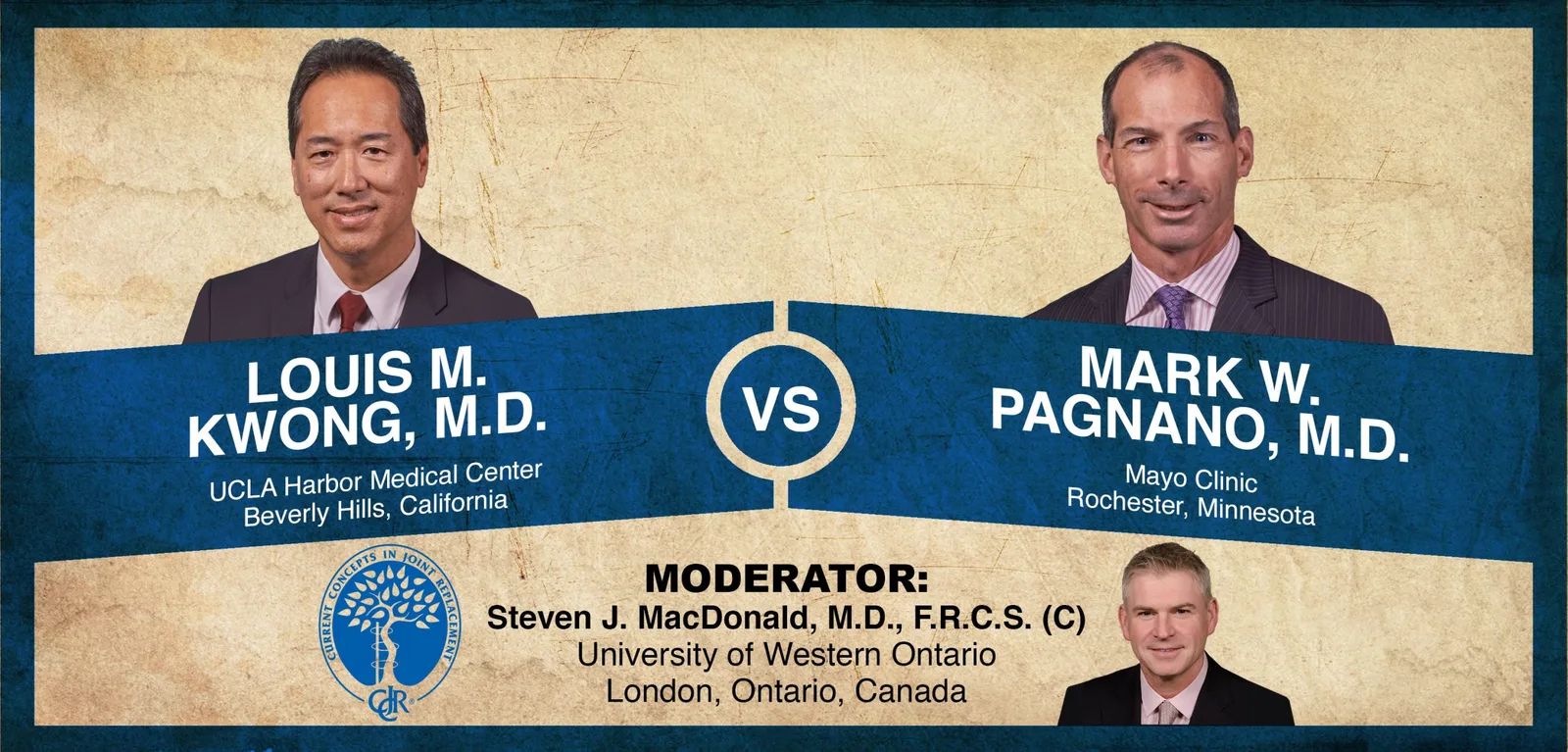
This week’s Orthopaedic Crossfire® debate was part of the 16th Annual Current Concepts in Joint Replacement® (CCJR) – Spring meeting, which took place in Las Vegas this past May. This week’s topic is “The Cementless TKA: Lifetime Guarantee on Parts & Labor.” For the proposition is Louis M. Kwong, M.D., of the UCLA Harbor Medical Center, Beverly Hills, CA. Mark W. Pagnano, M.D., Mayo Clinic, Rochester, Minnesota is in opposition. Moderating is Steven J. MacDonald, M.D., F.R.C.S.(C). from the University of Western Ontario.
Kwong vs Pagnano — The Cementless TKA: Lifetime Guarantee on Parts & Labor
8 min read Premium comments
Great Debates
Dr. Kwong: Cementless total knee arthroplasty was first explored over three decades ago. Early failures of cementless total knees were attributed primarily to failure of the tibial and patellar components which were a result of a number of factors such as implant design, material failure, inferior polyethylene, metal-backed patellar components — all of these factors contributed to osteolysis and early failure.
Despite this, early designs did demonstrate the ability to achieve good to excellent, intermediate to long-term follow-up. In Aaron Hofmann’s series at 12 years, 93.4% survival. Leo Whiteside’s series at 15-18 years, 98.6% survival, but when no cementless patella was utilized. And Merrill Ritter’s series at 10 years, 100% survival of the femoral component, 97.4% survival of the tibial component, but a patellar failure rate of 16.4%, demonstrated that further work was needed in this area.
Porous tantalum has been an important contributor to the clinical success of modern cementless total knee replacement. It has this reticulated trabecular geometry, which emulates the structure of human cancellous bone. The pores are shaped like a dodecahedron—a 12-sided figure with each side shaped like a pentagon and up to 85% of the material is porous by volume.
The first prosthesis that was developed with the use of this material was a monoblock porous tantalum tibia. This is a single piece design with the polyethylene direct compression molded into the all porous tantalum base with interference fit achieved through the hexagonal pegs and fixation holes which are dimensionally smaller in size. The next prosthesis was a monoblock patellar component. This is not a metal backed component. It is a single piece, direct compression molded with thick polyethylene on the periphery to address the design deficiencies of earlier generation patellae.
Mayo Clinic reported their five year experience with 117 of these cementless tibias and they found no difference in survival compared to a cementless implant. They had a 3.5% overall reoperation rate and no revisions of this monoblock cementless tibia for aseptic loosening.
Our experience at Harbor-UCLA closely reflects that of the Mayo experience. We had 115 patients, average 7 years, up to 11 year follow-up. These were all cementless reconstructions with a monoblock tibia, monoblock patella, and a titanium fiber mesh PS femur. This is a non-selected series, all performed by orthopedic residents. We had 95.7% survival. Five patients did undergo revision. One died secondary to pulmonary embolism. But there was no x-ray evidence of osteolysis or loosening. No revisions for aseptic loosening, with high patient satisfaction.
Now what are some of the advantages of eliminating cement? Eliminating concerns associated with cementing like monomer induced hypotension; thermal necrosis of bone; and possible third-body wear from retained debris. But perhaps the greatest savings, is the savings in time. We saw an average 18 minute reduction in OR time by eliminating the steps which are important in doing a technically good job in cementing. Time savings due to the shorter operation time—we reduce the time under anesthesia; with potential reductions in infection risk and possible decrease in overall morbidity and mortality.
So in summary, performing cementless total knee is straightforward and relatively easy. The intermediate to long-term clinical performance has been good to excellent. While it is not possible to give you a lifetime guarantee on parts and labor, there are clinical outcomes that demonstrate that cementless fixation should be considered as a reasonable alternative to cemented fixation.
Dr. Pagnano: It’s my contention that in 2015 cemented fixation remains the gold-standard for total knee arthroplasty fixation.
I think we all agree that the goals of total knee replacement are to alleviate pain and improve function for our patients. We want to do that in a way that’s reliable, reproducible and durable. In most series, cemented fixation gets good initial fixation, which helps contribute to that reliable pain relief and the technique has proved reproducible over decades of use. It’s not difficult to understand and put into play the best way to cement a total knee replacement and make it reproducible. If we look at the durability, there’s lots of data out there on the durability of cemented total knee constructs, and now there’s survivorship out to 15 or more years from multiple centers around the globe.
The Mayo Clinic study that won the Knee Society award in 2006…1, 000 cemented cruciate retaining total knee replacements of a single design… the 15 year survivorship free of revision for aseptic loosening was 98.6%. Hard to improve on that.
We then look away from single surgeon or single center series to registry data from the English, the Australian, the Swedish and the New Zealand registries. In every single example, cemented fixation does a little bit or a lot better than non-cemented fixation.
So often you’ll hear a case, well maybe cement is okay for the elderly, but we’re in a new era where we’re introducing total knee replacement to younger and younger patients. There are series from 10 years ago, with 10 and 8 year data, again 94-98%, but more recently there’s 30-year data available from New York with 82% survivorship with aseptic loosening as the endpoint.
In conclusion, I think the answer to the durability question is…at 15 to 20 years loosening of cemented total knee replacements is a relatively uncommon problem. In fact, the most common problems in the first 20 years after cemented total knee replacement are infection, instability, stiffness and peri-prosthetic fracture. Those are problems that are independent of fixation type. Those aren’t going to disappear by moving to an uncemented implant. Can uncemented fixation work? It certainly can. There are a number of single surgeon series that have 10 to 20 year data that show good results. But I would make this contention…if you look at any single knee design, it’s difficult to show any series in which the uncemented version of that design has outperformed the cemented. So pick your favorite manufacturer, pick your favorite knee implant design and do this head-to-head comparison…the cemented always beats the uncemented.
The further advantages of a cemented knee—it’s technically a little more straightforward, the bone cuts that are necessary during the surgery are probably not quite as demanding since the cement acts as a grout and helps to make up for small differences in the bone cuts.
The question of efficiency or speed—that’s a plus or a minus. No cement to deal with—probably a small advantage and a small incision surgery. Once fixed, the question is, ‘Is it more durable?’ Well, I await data to show that is actually the case.
No question that there are some disadvantages. While the Mayo Clinic has had good results with an uncemented tibial component as outlined in the previous talk, others have not replicated that experience. There have been trabecular metal tibias that have failed early, that result in pain and unhappy patients relatively early after surgery. Further the uncemented knee is a little more difficult to work up if it becomes painful.
So in summary, the studies of uncemented implants have not demonstrated better long-term fixation than cement to date. Is cement perfect? Clearly not. Is it better than uncemented to date? I would say yes. So at present, the cemented total knee is the fixation standard. Uncemented knees need better reliability and simpler reproducible techniques. This may happen in the future, but it hasn’t happened yet.
Moderator MacDonald: Are we there in 2015, Louis, are we there? And the reason I’m asking that is certainly…and Mark brought it up…not just in fixation, but in bone preparation. I’m not sure there have been massive advances yet in the bone preparation and being able to get that good interface, so what are your thoughts on today?
Dr. Kwong: I believe that we are on the threshold of the cementless total knee coming of age. But so many factors impact the longevity of the reconstruction—surgical technique, handling of soft tissues, and for the cementless, the preparation of the bony interfaces. All play a role in the clinical outcome for either cement or cementless.
Moderator MacDonald: Mark, what do you think needs to be done to get us there, if we should even go in that direction?
Dr. Pagnano: Fundamentally, I don’t think our understanding of what routinely makes an uncemented total knee work has actually improved over the last decade. While we’re all fond of looking at new materials, we saw some examples of a trabecular metal component that seems to have a good track record, and yet the same manufacturer introduces a new trabecular metal component and it’s been pulled off the market. So we don’t quite understand what makes a total knee that’s uncemented work perfectly. For 10 years, or longer, we’ve continued to argue that total knees are going to go the direction of total hips, but I think the forces around a total knee are fundamentally different than those around a total hip.
Moderator MacDonald: At this point in time, we really at this point of time we have achieved 98% survivorship for cemented total knee fixation and I think for cemented total hip. This is a global audience and while in North America we’re certainly biased towards resurfacing the patella, one way to do a cementless total knee would be to just leave the patella unresurfaced and you would not have to experiment with a new design for cementless patellae. What are your thoughts on that?
Dr. Kwong: I find that in speaking with a lot of surgeons who do not resurface the patella, it’s specifically what you’re referring to is they don’t want to deal with problems referable to the patello-femoral joint often thought of as the low back or weak area of the knee. Potential problems with failure fixation, whether it’s cemented or cementless.
I just want to comment on Mark’s statement, which I think is very important to elaborate more on…the recall of a new version of that prosthesis was actually a voluntary recall, a class 2 recall. Same material, same basic design, yet there was a 0.61 complaint rate out of about 7, 400 implants, a complaint of radiolucency and some revisions for loosening. So it shows it is not just the material, and not just the mode of fixation, but all these other factors. Subtle changes in design. Surgical technique. Things for which you started off this discussion session with emphasizing how the preparation and things that are in control of the surgeon all have an impact on the outcome.
Moderator MacDonald: Gentlemen, I thank you for a very well balanced debate. I think we had an excellent discussion.
Please visit www.CCJR.com to register for the 2015 CCJR Winter Meeting, December 9 – 12 in Orlando.
React:
Discussion
This is a fascinating development. In my practice we've seen similar outcomes with the revised protocol. The key differentiator seems to be patient selection criteria. Has anyone else noticed the correlation with BMI thresholds?
Great point. I'd push back slightly on the conclusion, the sample size in the cited study is too small to draw population-level inferences. That said, the directional signal is compelling and worth a larger RCT.
We implemented a similar approach last year. Early results are promising but we're still gathering 12-month follow-up data. Happy to share our protocol if anyone is interested.
Join the conversation
Orthopedic professionals are discussing this. Sign in and upgrade to read every comment and add your voice.