
K2M, Inc.’s mono cervical plate system has scored a regulatory double with 510(k) clearance from the U.S. FDA and CE Mark in Europe.
K2M’s Mono Plate Scores Regulatory Daily Double
1 min read Premium comments
Secondary
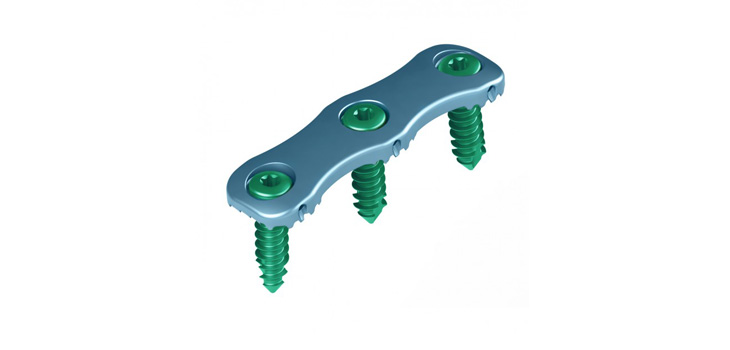
The regulatory victories for the company’s Pyrenees Mono Cervical Plate System, the company’s latest addition to its family of Pyrenees products, allows for the global availability and expansion of the product. The mono plate is the third offering in the Pyrenees family of cervical plates, which also includes a Constrained Cervical Plate System and a Translational Cervical Plate System.
The slim-profile design, according to a September 3, 2015 announcement, “allows for a single point of fixation per level for improved visualization in-situ. The posterior profile of the plate is designed to reduce plate migration in-situ during screw insertion. With screws manufactured from Titanium Alloy and plates manufactured from Commercially Pure Grade II Titanium, the system includes one- and two-level plates.”
Mina Foroohar, M.D., a neurosurgeon and president of Northwest Neurosurgery Institute in Arlington Heights, Illinois, said: “Compared to a traditional two hole plate, K2M’s monoplate’s narrow profile, offers easier use while working under a microscope and provides me with an opportunity to perform less lateral retraction than a wider cervical plate.” Douglas Moreland, M.D., a neurosurgeon and clinical assistant professor of neurosurgery at the University at Buffalo in New York, said the plate is, “…very user friendly, as the plate is smaller and requires only one screw per level, which has allowed me to save time during both vertebral body prep for the plate and screw placement.”
The company says the plates allow for precise plate contouring because they do not have bend zones. In addition, the plates are designed with lordotic curvature to minimize intraoperative contouring, and all plates can be bent anatomically “without compromising the ability of the screws to lock at any angle.” The plates also feature K2M’s proprietary tifix locking technology and do not require an additional locking mechanism, as each screw head forms an autogenic lock to the plate upon insertion.
Author
React:
Discussion
This is a fascinating development. In my practice we've seen similar outcomes with the revised protocol. The key differentiator seems to be patient selection criteria. Has anyone else noticed the correlation with BMI thresholds?
Great point. I'd push back slightly on the conclusion, the sample size in the cited study is too small to draw population-level inferences. That said, the directional signal is compelling and worth a larger RCT.
We implemented a similar approach last year. Early results are promising but we're still gathering 12-month follow-up data. Happy to share our protocol if anyone is interested.
Join the conversation
Orthopedic professionals are discussing this. Sign in and upgrade to read every comment and add your voice.