
Scientists from the RIKEN Brain Science Institute in Japan have discovered that in addition to proteins, lipids are also necessary for guiding axons. Specifically, a phospholipid released by glial cells controls the positioning of sensory neurons within the spinal cord.
Healing Spinal Cord Damage: Another Piece of the Puzzle
1 min read Premium comments
Secondary
“While many proteins are known to direct axon growth and network formation, ” said Senior Team Leader Hiroyuki Kamiguchi, M.D., Ph.D. in the August 27, 2015 news release, “we discovered that glial cells have the ability to release membrane structural lipids in specific patterns that can then control axon migration and neuron organization. In this case, we found that a lipid called LysoPtdGlc has a major role in separating axons of pain- and position-sensing neurons from each other.”
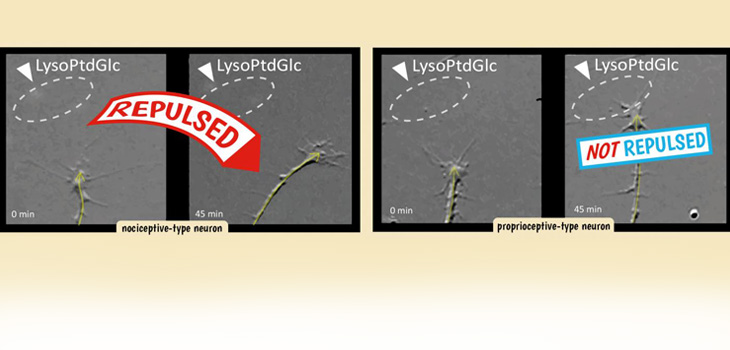
As indicated in the news release, “The researchers found that gradients of LysoPtdGlc repelled axons from the pain-sensing neurons. This function of LysoPtdGlc was confirmed when blocking access to the lipid with an experimental antibody prevented pain-sensing neurons from being repelled…. The researchers then injected the antibody into the spinal cord of chick embryos. Their hypothesis that LysoPtdGlc was responsible for directing axon growth proved correct; the axons of pain-sensing neurons were no longer repelled, and instead migrated into the region on the spinal cord reserved for position-sensitive neurons.”
“After determining that LysoPtdGlc’s ability to repel pain-sensing axons was controlled through a particular type of protein receptor on axons, the team tested over 100 receptors and found one—GPR55—that responded well to LysoPtdGlc. The team confirmed that this protein is also expressed in the spinal cord, and when they labeled axons in GPR55 knockout mice, they found pain-sensing axons had erroneously entered the upper-medial portion of the spinal cord—similar to when they had blocked LysoPtdGlc function by injecting the antibody into chick spinal cords.”
Dr. Kamiguchi told OTW, “It was surprising to find that lipids, not proteins, mediate glia-to-neuron communication that regulates axon tract formation in the spinal cord.”
Asked what orthopedic surgeons may like to know about this work, he added, “I think there are many unidentified bioactive lipids that could be new drug targets for nervous system disorders including spinal cord injury.”
React:
Discussion
This is a fascinating development. In my practice we've seen similar outcomes with the revised protocol. The key differentiator seems to be patient selection criteria. Has anyone else noticed the correlation with BMI thresholds?
Great point. I'd push back slightly on the conclusion, the sample size in the cited study is too small to draw population-level inferences. That said, the directional signal is compelling and worth a larger RCT.
We implemented a similar approach last year. Early results are promising but we're still gathering 12-month follow-up data. Happy to share our protocol if anyone is interested.
Join the conversation
Orthopedic professionals are discussing this. Sign in and upgrade to read every comment and add your voice.