
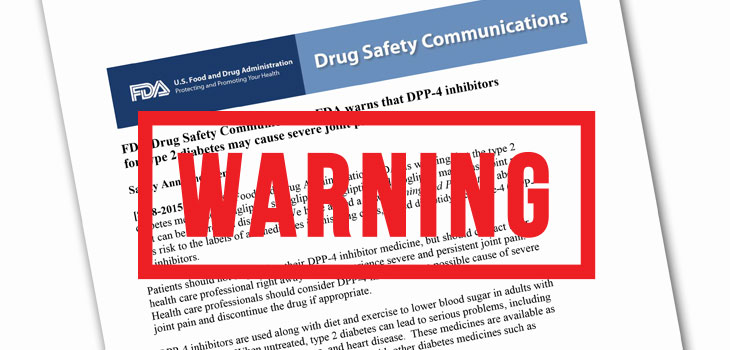
The FDA warned on August 28, 2015 that a class of diabetes drugs has been linked to severe joint pain.
FDA Warning – Diabetes Drugs Linked to Severe Joint Pain
3 min read Premium comments
Secondary
In a Drug Safety Communication, the agency said the type 2 diabetes medicines sitagliptin, saxagliptin, linagliptin, and alogliptin “may cause joint pain that can be severe and disabling.” In addition, a new Warning and Precaution about this risk has been added to the labels of all medicines in this drug class, called dipeptidyl peptidase-4 (DPP-4) inhibitors.
“Patients should not stop taking their DPP-4 inhibitor medicine, but should contact their health care professional right away if they experience severe and persistent joint pain. Health care professionals should consider DPP-4 inhibitors as a possible cause of severe joint pain and discontinue the drug if appropriate, ” stated the warning.
Adverse Events
In a search of the FDA Adverse Event Reporting System (FAERS) database and the medical literature, the agency identified cases of severe joint pain associated with the use of DPP-4 inhibitors. Patients started having symptoms from one day to years after they started taking the drugs. After patients stopped taking the drugs, their symptoms were relieved, usually in less than a month. Some patients developed severe joint pain again when they restarted the same medicine or another DPP-4 inhibitor.
Reuters reported that the agency identified 33 cases of severe joint pain in patients taking the drugs between October 16, 2006, when the first one was approved, through December 31, 2013. The most frequent number of cases, 28, occurred with Merck’s Januvia, known generically as sitagliptin. Five cases were reported with AstraZeneca Plc’s Onglyza (saxagliptin), two with Boehringer Ingelheim’s Tradjenta (linagliptin), and one with Takeda Pharmaceutical’s Nesina (alogliptin).
In 20 of the cases, the drug was suspected as a cause of the pain and was discontinued within a month of the first sign of symptoms. In 8 of the remaining 13 cases, 44 days to a year elapsed between first symptoms and discontinuation of the drugs.
Companies Respond
Merck spokesman Steven Cragle told Reuters the reason the number of cases was higher with Januvia is that it was the first to market and is the most widely prescribed, accounting for about 80% of prescriptions in the U.S.
Boehringer Ingelheim’s spokeswoman Emily Geary said clinical trials of Tradjenta “do not show an imbalance between linagliptin and placebo in musculoskeletal and connective tissue disorders or, more specifically, in joint disorders.”
A spokesman for AstraZeneca, Andrew Davis, said the company “works with health authorities and scientific experts to help ensure patients and physicians have a clear understanding of the risk benefit profile of our medications.”
A spokesman for Takeda did not immediately respond to a request for comment from Reuters.
DPP-4 inhibitors are a class of prescription medicines that are used with diet and exercise to control high blood sugar in adults with type 2 diabetes. Medicines in the DPP-4 inhibitor class include sitagliptin, saxagliptin, linagliptin, and alogliptin. They are available as single-ingredient products and in combination with other diabetes medicines such as metformin. DPP-4 inhibitors lower blood sugar by helping the body increase the level of the hormone insulin after meals. Insulin helps move sugar from the blood into the tissues so the body can use the sugar to produce energy and keep blood sugar levels stable.
FDA-Approved DPP-4 Inhibitors
Here is a list of FDA-approved DPP-4 inhibitors
Brand name Active ingredient(s)
Januvia sitagliptin
Janumet sitagliptin and metformin
Janumet XR sitagliptin and metformin extended release
Onglyza saxagliptin
Kombiglyze XR saxagliptin and metformin extended release
Tradjenta linagliptin
Glyxambi linagliptin and empagliflozin
Jentadueto linagliptin and metformin
Nesina alogliptin
Kazano alogliptin and metformin
Oseni alogliptin and pioglitazone
Reporting Side Effects
Providers and patients are urged to report side effects involving DPP-4 inhibitors to the FDA MedWatch program. The entire Safety Communication can be read here.
Author
React:
Discussion
This is a fascinating development. In my practice we've seen similar outcomes with the revised protocol. The key differentiator seems to be patient selection criteria. Has anyone else noticed the correlation with BMI thresholds?
Great point. I'd push back slightly on the conclusion, the sample size in the cited study is too small to draw population-level inferences. That said, the directional signal is compelling and worth a larger RCT.
We implemented a similar approach last year. Early results are promising but we're still gathering 12-month follow-up data. Happy to share our protocol if anyone is interested.
Join the conversation
Orthopedic professionals are discussing this. Sign in and upgrade to read every comment and add your voice.