
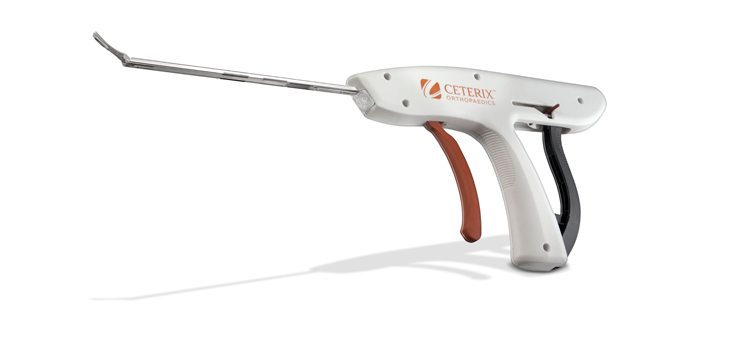
Ceterix Orthopaedics, Inc. is announcing the receipt of U.S. FDA 510(k) clearance and U.S. commercial availability of the its NovoStitch Plus meniscal repair system, a product that is intended to help orthopedic surgeons address horizontal, radial, and other complex meniscal tears in new ways.
Ceterix Orthopaedics Obtains 510(k) for NovoStitch Plus
2 min read Premium comments
Secondary
According to the September 22, 2015 news release, “The system enables the placement of a circumferential compression stitch around the meniscus, providing uniform compression during healing and allowing orthopaedic surgeons to treat complex injuries. The next-generation NovoStitch Plus device incorporates a pre-loaded suture implant, a design innovation that improves ease of use and cuts the number of procedure steps by more than half.”
“The NovoStitch Plus meniscal repair system represents a significant improvement to one of the most innovative technologies developed for knee procedures in many years, ” said James Lee Pace, M.D., an orthopedic surgeon and director of the Sports Medicine Program at Children’s Hospital Los Angeles, after treating the first patient with the next-generation system. “The NovoStitch device has allowed me to preserve the meniscus for many of my patients, significantly reducing their likelihood of arthritis or a total knee replacement later in life. I am looking forward to incorporating the new device into my practice.”
“We are very pleased to release this important new technology, ” said Ceterix Orthopaedics President and CEO John McCutcheon. “We believe that the usability improvements in this new device will enable surgeons to provide meniscus repair to an even broader set of patients who need better solutions for this very common knee injury.”
McCutcheon told OTW, “The purpose of the design project was to make the device easier to use than our first-generation technology. We were excited to find some unintended benefits along the way in addition to the benefits that we were targeting. One example is now that the suture is integrated in the device, it is much less likely to snag or get pinched anywhere during the procedure. Our initial goal was to reduce the number of steps required to load the suture, but we now believe that there are additional benefits from this advancement.”
“Our first-generation product showed the feasibility of suturing many types of tears that previously could not be treated. However, it took a lot of training and ongoing proctoring and did not have the ease-of-use to enable us to do a full-scale launch. It was just too costly for us to scale with our direct sales force and we felt that the training hurdles were too high to be successful going through independent distributors. We are now actively putting together a hybrid distribution model with both direct and distributor representatives. By the end of 2016, we hope to significantly expand the total meniscal repair market and be on our way to becoming the market leader in meniscus repair.”
React:
Discussion
This is a fascinating development. In my practice we've seen similar outcomes with the revised protocol. The key differentiator seems to be patient selection criteria. Has anyone else noticed the correlation with BMI thresholds?
Great point. I'd push back slightly on the conclusion, the sample size in the cited study is too small to draw population-level inferences. That said, the directional signal is compelling and worth a larger RCT.
We implemented a similar approach last year. Early results are promising but we're still gathering 12-month follow-up data. Happy to share our protocol if anyone is interested.
Join the conversation
Orthopedic professionals are discussing this. Sign in and upgrade to read every comment and add your voice.