
Blue Belt Technologies, Inc. announced on September 8, 2015, that its Navio robotics-assisted system is now providing commercial support for Smith & Nephew’s ZUK unicompartmental (uni) knee.
Blue Belt’s Robot Supports ZUK Knee
2 min read Premium comments
Secondary
The ZUK was introduced in 2004 and acquired by Smith & Nephew in June 2015 from Zimmer Holdings, Inc. Zimmer had to divest itself of the knee to gain regulatory approval to acquire Biomet, Inc.
Lauralan Grison, Smith & Nephew’s knee reconstruction vice president, said, “This is an excellent time to leverage our partnership with Blue Belt Technologies. Healthcare providers, particularly the fast-growing Ambulatory Surgery Center segment, are seeking affordable, advanced surgical solutions for their orthopaedic care, and introducing this robotics-assisted technology for the ZUK knee further sets us apart in the industry.”
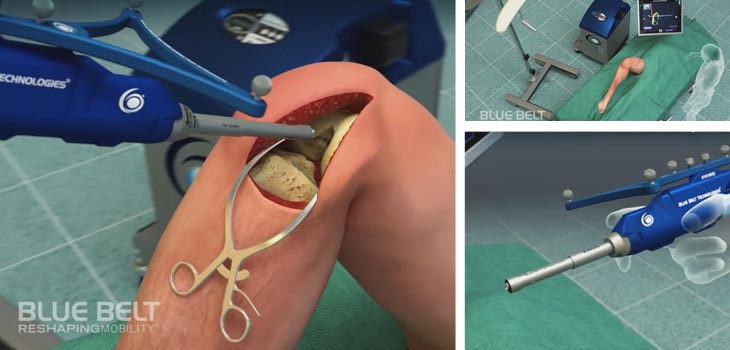
Using patented technology, the Navio system works through CT-free navigation and handheld robotics to enable the surgeon to create a surgical plan based on patient anatomy, and, claims the company, brings a high degree of implant placement accuracy. The system’s open implant software supports eight different knee systems.
According to the company, the system offers “precise control to surgeons via an intelligent, handheld, computer-assisted, bone-cutting tool [and] provides robotic assistance to the surgeon while performing bone-shaping tasks through minimally invasive incisions.” The company’s Stride unicondylar knee system provides implant features optimized for use with Navio.
During bone preparation, the robotic-controlled handpiece is tracked in real time in relation to the intended resurfacing plan and is computer controlled to remove only the bone required to place the implant.
And with no pre-operative CT-scan required, the patient can receive the benefits of robotic guidance without additional time spent on pre-operative procedures. The surgeon simply registers the patient during the procedure using kinematic reconstruction and anatomic landmarks. This information assists the surgeon in planning the implant location and balancing the knee’s ligaments.
First U.S. Surgery
In addition to the Smith & Nephew announcement, the company also announced the first U.S. surgery using the Navio system and ZUK implant. The surgery was performed by Michael Miranda, M.D. of the Florida Orthopaedic Institute. “By making partial knee replacements a more accessible option through improved precision, we ensure that the patient receives a surgical procedure that is generally associated with smaller incisions, less scarring, a shorter hospital stay and quicker recovery when compared to the total knee replacement alternative, ” said Miranda.
Author
React:
Discussion
This is a fascinating development. In my practice we've seen similar outcomes with the revised protocol. The key differentiator seems to be patient selection criteria. Has anyone else noticed the correlation with BMI thresholds?
Great point. I'd push back slightly on the conclusion, the sample size in the cited study is too small to draw population-level inferences. That said, the directional signal is compelling and worth a larger RCT.
We implemented a similar approach last year. Early results are promising but we're still gathering 12-month follow-up data. Happy to share our protocol if anyone is interested.
Join the conversation
Orthopedic professionals are discussing this. Sign in and upgrade to read every comment and add your voice.