
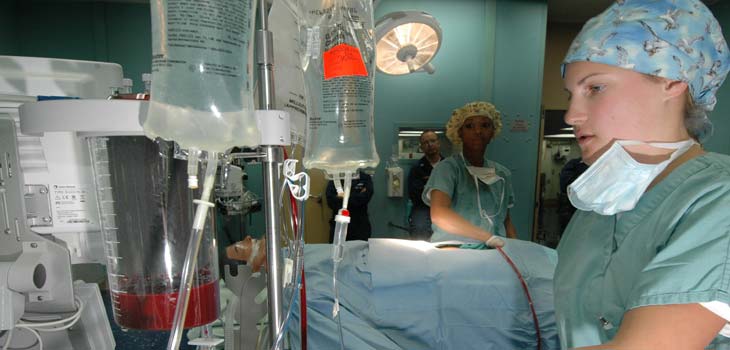
When Canada’s St. Michael’s hospital began using an inexpensive drug called tranexamic acid, or TXA, it reduced the number of red blood cell transfusions performed at joint replacement surgeries by 40%. No patients were negatively affected. TXA prevents excessive blood loss during surgeries.
Blood Preserving TXA in Joint Surgery
1 min read Premium comments
Secondary
Beginning in October 2013, St. Michael’s anesthesiologists started giving TXA to every eligible patient undergoing hip or knee replacement. A total of 402 patients received the drug.
“We wanted to optimize TXA’s use in patients undergoing hip or knee replacements because these procedures often result in high blood loss and frequently require transfusions, ” said Greg Hare, M.D., an anesthesiologist at St. Michael’s. “The drug costs about $10 per patient, while the average cost of transfusing one unit of blood is $1, 200.”
Using TXA for eligible patients undergoing hip or knee replacement reduced the hospital’s transfusion rate for those surgeries from 8.8% to 5.2%. This was greater than a 40% reduction.
Physicians running the program stated that patients who received TXA did not experience any increase in adverse events, such heart attack, stroke or blood clots. There was no difference in patient mortality rates or their length of stay in the hospital.
“Other hospitals and surgical centers should consider making TXA mandatory for similar surgeries because it can improve quality of care, decrease the need for blood transfusions and even save money, ” said Hare, who is one of the founders of St. Michael’s Centre of Excellence for Patient Blood Management. “Making TXA mandatory for eligible patients has made care more efficient, ensuring the best possible care for our patients, ” he said.
Hare said the transfusion rate was already low at St. Michael’s because of the hospital’s commitment to blood management and the Ontario Transfusion Coordinators program, which is administered by St. Michael’s.
Author
React:
Discussion
This is a fascinating development. In my practice we've seen similar outcomes with the revised protocol. The key differentiator seems to be patient selection criteria. Has anyone else noticed the correlation with BMI thresholds?
Great point. I'd push back slightly on the conclusion, the sample size in the cited study is too small to draw population-level inferences. That said, the directional signal is compelling and worth a larger RCT.
We implemented a similar approach last year. Early results are promising but we're still gathering 12-month follow-up data. Happy to share our protocol if anyone is interested.
Join the conversation
Orthopedic professionals are discussing this. Sign in and upgrade to read every comment and add your voice.