
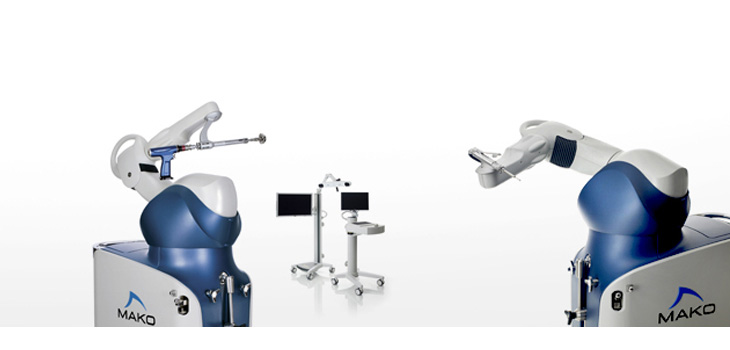
The FDA has added total knee clearance to the previously cleared total hip application of Stryker Orthopaedics’ MAKO robotic system.
Total Knee FDA Cleared for Stryker’s MAKO
1 min read Premium comments
Secondary
An August 6, 2015 company announcement states that the clearance expands on current MAKO partial knee and total hip applications of the robotic reconstructive service line. In March, the FDA cleared the company’s use of the robotic system for total hip replacement procedures.
David Floyd, the group president of Stryker’s orthopedic business, said, “The ability to include a MAKO total knee application with our market leading Triathlon Total Knee System represents a key milestone in reconstructive surgery. We are excited about the opportunity to transform orthopaedics by furthering the growth of robotic-arm assisted surgery, and by enhancing the surgeon and patient experience.”
Limited Launch
The company is preparing to initiate a limited market release of the new application by the end of the year.
During a conference call with analysts on July 23, company Vice President Katherine Owen told the analysts to keep in mind that it was going to take three to four quarters before they’ve gone through the necessary training and upgrades needed to optimize the launch.
According to the company, over 50, 000 MAKO procedures have been performed since 2006, with the first total hip procedure performed in 2010. Since then, over 7, 000 total hip procedures have been performed with the MAKO system using various surgical approaches including direct anterior, postero-lateral, and antero-lateral.
Rise of Robotics
In March, RBC Capital markets analyst Glenn Novarro wrote, “In total knees, U.S. surgeons expect robotics to represent ~10% of total knee procedures two years from now, ~18% of procedures five years from now, and ~23% of procedures ten years from now.”
Stryker sure hopes so as the company seeks to capitalize on its $1.65 billion acquisition of MAKO Surgical in 2013.
Author
React:
Discussion
This is a fascinating development. In my practice we've seen similar outcomes with the revised protocol. The key differentiator seems to be patient selection criteria. Has anyone else noticed the correlation with BMI thresholds?
Great point. I'd push back slightly on the conclusion, the sample size in the cited study is too small to draw population-level inferences. That said, the directional signal is compelling and worth a larger RCT.
We implemented a similar approach last year. Early results are promising but we're still gathering 12-month follow-up data. Happy to share our protocol if anyone is interested.
Join the conversation
Orthopedic professionals are discussing this. Sign in and upgrade to read every comment and add your voice.