
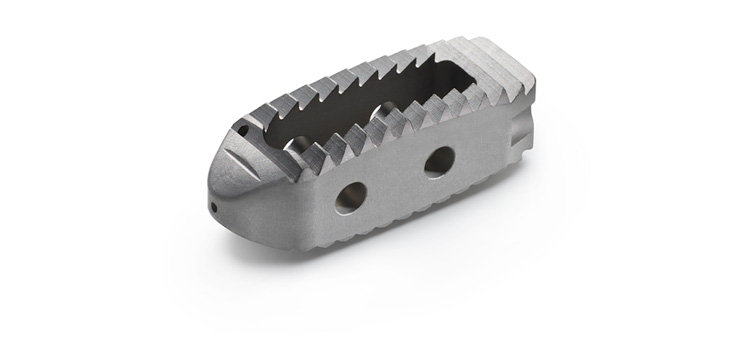
SeaSpine Holdings Corporation has announced the launch of its Ventura NanoMetalene transforaminal intervertebral body fusion device. The product is indicated for use as an adjunct to fusion in patients with degenerative disc disease (DDD).
SeaSpine Sets Sail With Intervertebral Body Fusion Device
1 min read Premium comments
Secondary
According to the August 10, 2015 news release, “NanoMetalene is an ultra-thin layer of commercially pure titanium molecularly bonded to a PEEK-OPTIMA implant. It is applied in a proprietary high-energy, low-temperature surface process and encompasses the entire implant, including the center graft window…With convex surfaces and multiple footprints, surgeons can create a secure anatomical fit, and Ventura NanoMetalene’s large graft aperture for autogenous bone graft assists in fusion. Ventura NanoMetalene is optimal for either open or minimally transforaminal lumbar intervertebral fusion (TLIF) procedures.”
“We collaborated with our surgeon partners to create an implant that utilizes existing instrumentation and addresses today’s increasingly complex spinal surgery requirements, ” said SeaSpine CEO Keith Valentine. “NanoMetalene technology is a great bridge product in our portfolio because it offers the benefits of hardware with biologic-driven features that support bone growth. Its success to-date supports our plan to develop additional implants leveraging NanoMetalene technology in the future.”
Colin Smith, company vice president of Marketing and Product Development, told OTW, “The biggest challenge was identifying the right technology that allowed us to bond commercially pure titanium to PEEK while retaining the benefits of PEEK (such as favorable post-operative imaging and modulus of elasticity) and adding the recognized biologic properties of a nano-topography titanium surface.”
Author
React:
Discussion
This is a fascinating development. In my practice we've seen similar outcomes with the revised protocol. The key differentiator seems to be patient selection criteria. Has anyone else noticed the correlation with BMI thresholds?
Great point. I'd push back slightly on the conclusion, the sample size in the cited study is too small to draw population-level inferences. That said, the directional signal is compelling and worth a larger RCT.
We implemented a similar approach last year. Early results are promising but we're still gathering 12-month follow-up data. Happy to share our protocol if anyone is interested.
Join the conversation
Orthopedic professionals are discussing this. Sign in and upgrade to read every comment and add your voice.