
Richard Hawkins, M.D. Named “Mr. Sports Medicine” by AOSSM
Richard Hawkins, M.D. Receives AOSSM Sports Medicine Leadership Award // Geoffrey Westrich, M.D. Taking Helm at Eastern Orthopaedic Association // and More!
5 min read Premium comments
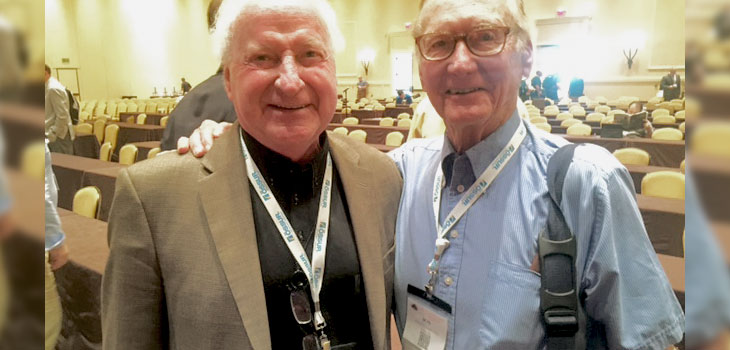
The American Orthopaedic Society for Sports Medicine (AOSSM) has named Richard Hawkins, M.D., founding partner of the famed Steadman Hawkins Clinic, as this year’s recipient of the Robert E. Leach Sports Medicine Leadership award. Dr. Hawkins told OTW, “It is significant honor to receive the Robert E. Leach Sports Medicine Leadership award (Mr. Sports Medicine). It is particularly gratifying especially because I knew Bob Leach. He was an exceptional surgeon and gentlemen who made major academic contributions to our field.”
Dr. Hawkins, now a program director for the Steadman Hawkins Clinic of the Carolinas Fellowship Program, added, “I did my undergraduate training at our local university in London. During that time I did a knee fellowship with Dr. Jack Kennedy and in 1975 I did a cervical spine and shoulder fellowship under Drs. Bill Fielding and Charlie Neer. When I returned to practice in London, my shoulder practice grew exponentially.”
“I grew up in London, Ontario, Canada, and I did my training there, including fellowships in knee, shoulder, and spine. I practiced there for many years, during which time I developed my interest in the health of the shoulder. Then in 1990 the opportunity to go to Vail, Colorado, presented itself. Dr. Richard Steadman and I subsequently established the Steadman Hawkins Clinic, and we have had the pleasure of treating numerous high level athletes. In 2008 I accepted an offer to establish the Steadman Hawkins Clinic of the Carolinas in Greenville, South Carolina.”
“I wouldn’t be a doctor if it weren’t for athletics. Having played a variety of sports, including semi-pro football, it has given me an understanding of the physical and psychological aspects of working with athletes.”
“I am proud to have trained approximately 200 doctors from all over the world as sports medicine physicians. They appreciate our research-oriented perspective, as well as the fact that we take that knowledge and apply the related principles to patient care. I’d like my legacy to be that of teaching and mentoring young surgeons and families. Part of what we do is teaching life lessons, and to be a good teacher you must be a good learner. I learn from everyone around me and I love being a student of life. I’m fortunate to have tremendous relationships with my patients; whether it’s the kid from down the street or a professional athlete, I revel in caring for my patients. More importantly, a commitment to family comes first.”
Geoffrey Westrich, M.D. New President of Eastern Orthopaedic Association
Geoffrey Westrich, M.D., an acclaimed orthopedic surgeon and researcher, has been named president of the Eastern Orthopaedic Association (EOA). Dr. Westrich, director of Research, Adult Reconstruction and Joint Replacement at Hospital for Special Surgery, told OTW, “It’s a thrill to be given the chance to lead such a tremendous organization. Years ago I was honored with the EOA resident award, then once I went into practice I became involved in several EOA committees; I have served on the board of directors for 15 years.”
Dr. Westrich, who dedicates his practice to treating hip and knee patients, notes, “The EOA encompasses 13 Eastern U.S. states—all the way down to Puerto Rico. Our purpose is to promote and foster the advancement of the art and science of orthopedic surgery. The organization has a nice balance of academic and private practice orthopedic surgeons, meaning that we get a meaningful cross fertilization of experience and ideas.”
“As president, I will continue to foster educational programs via an academic liaison who is on the board of directors. And we will ask state representatives to reach out to various orthopedic surgeons in their respective areas in order to determine if there are more individuals who might be a good fit for the EOA.”
Not only does Dr. Westrich hold a medical degree from Tufts University School of Medicine, but he obtained a Bachelors degree from Tufts School of Engineering. He was then invited to join Eta Kappa Nu, a prominent engineering honors society. Dr. Westrich completed his orthopedic surgery residency at New York Hospital-Weill Cornell Medical Center, followed by a hip and knee fellowship at Hospital for Special Surgery and an additional fellowship in hip, knee, and trauma in Bern, Switzerland.
100% Union Rate for Calcaneal Osteotomies!
A new jig for use with calcaneal osteotomies just may be the future, says Gregory Guyton, M.D. of Union Memorial Hospital in Baltimore. Dr. Guyton and his colleagues have performed 60 calcaneal osteotomies through a minimal incision and have achieved a 100% union rate. Dr. Guyton tells OTW, “We set out to see if using a jig and a burr would be a safe, effective option for performing calcaneal osteotomies. We used calcaneal osteotomy as an initial approach to create a paradigm for learning how to do these surgeries with a jig and a very minimal 5-8mm incision. We are taking a minimally invasive surgery (MIS) concept and adding an element of predictability and reliability that will hopefully give surgeons new perspective and more treatment options.”
“We have created a jig to put in the side of the heel to guide the burr through the sweeping motion required to cut the calcaneus. Doing this procedure without a jig—i.e., freehand—is valid, but it is less predictable as far as deciding how to create the osteotomy angle and how to orient the osteotomy. Recent research has helped define a specific location of the starting point for calcaneal osteotomy in order to avoid neurovascular injury. Specifically, the safe zone is defined by drawing a line between the plantar fascia and the posterosuperior prominence of the calcaneous and projecting the line 10mm forward…doing this avoids the sural nerve and its branches with percutaneous incisions.”
“It was a bit surprising to see in our study that there was less of a tendency to injure the smaller, lateral calcaneal nerves by using a burr as opposed to using a larger incision and a saw. This was probably because the larger incision stretches the nerves where as the small burr incision tends to avoid these small branches altogether.”
“To date we have performed approximately 60 calcaneal osteotomies with a 100% union rate, no significant infections, and no issues regarding the tibial nerve or the sural nerve. So we now know that this is a safe and effective procedure. A reduction in pain and morbidity compared to the open technique remains difficult to validate, however, because we have always done this in conjunction with other open procedures elsewhere in the foot. Once we further develop the technique and have the opportunity to potentially extend minimally invasive concepts to other parts of the flatfoot correction, we hope to see further reductions in patient morbidity and pain.”
Author
React:
Discussion
This is a fascinating development. In my practice we've seen similar outcomes with the revised protocol. The key differentiator seems to be patient selection criteria. Has anyone else noticed the correlation with BMI thresholds?
Great point. I'd push back slightly on the conclusion, the sample size in the cited study is too small to draw population-level inferences. That said, the directional signal is compelling and worth a larger RCT.
We implemented a similar approach last year. Early results are promising but we're still gathering 12-month follow-up data. Happy to share our protocol if anyone is interested.
Join the conversation
Orthopedic professionals are discussing this. Sign in and upgrade to read every comment and add your voice.