
OsteoMed claims it is turning traditional lateral access to the spine inside out.
OsteoMed Turns Lateral Access Inside Out
1 min read Premium comments
Secondary
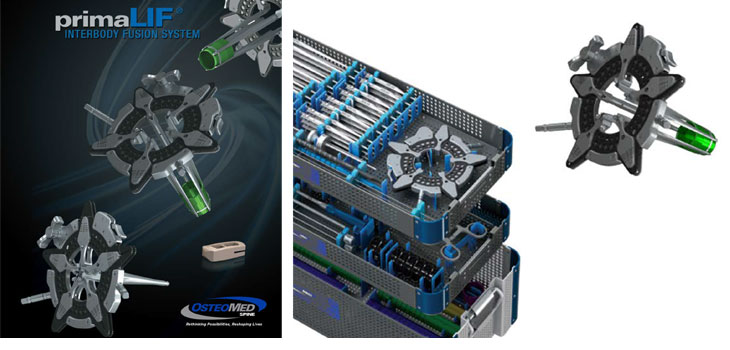
Lateral spinal fusion can be daunting even by the most experienced surgeons. OsteoMed says it has made access to the lateral spine “simpler and more secure” with the full market launch of its PrimaLIF LLIF Lateral Interbody Fusion System.
The system, according to an August 18, 2015 announcement, features a small initial diameter and a five slim blade design that allows for “gentle tissue distraction, minimal neuromonitoring utilization and superb nerve protection.”
Unlike current systems on the market, the company says their system utilizes multiple dilators with neuromonitoring requirements with each insertion, sliding a 7.5mm initial diameter down over a guidewire. “This places the nerves of the Lumbar Plexus posterior throughout the case. The retractor is then gently opened with sequential expanders from inside the retractor to give the surgeon access to the disc space. A rigid ring is placed at the distal end to maintain retractor opening and prevent coning of the blades. Surgeons can focus on the fusion site rather than keeping the retractor in place.”
Features of the system noted by company include:
- Radial dilation minimizes tissue disruption
- Maximized direct visualization with minimal tissue retraction
- Comprehensive instrumentation consisting of full disc preparation, intraoperative monitoring, illumination and multiple implant footprint options
The PrimaLIF LLIF was named one of the winners of Orthopedics This Week’s Top 10 New Spine Technologies for 2013.
OsteoMed is headquartered in Dallas, Texas and has been around over two decades.
Author
React:
Discussion
This is a fascinating development. In my practice we've seen similar outcomes with the revised protocol. The key differentiator seems to be patient selection criteria. Has anyone else noticed the correlation with BMI thresholds?
Great point. I'd push back slightly on the conclusion, the sample size in the cited study is too small to draw population-level inferences. That said, the directional signal is compelling and worth a larger RCT.
We implemented a similar approach last year. Early results are promising but we're still gathering 12-month follow-up data. Happy to share our protocol if anyone is interested.
Join the conversation
Orthopedic professionals are discussing this. Sign in and upgrade to read every comment and add your voice.