
Let’s say you are a device manufacturer that wants to conduct and pay for a prospective, randomized, double-blind, placebo-controlled trial that is also covered by CMS (Centers for Medicare and Medicaid Services) under its Coverage with Evidence Development (CED) program.
OIG Solves “Blinding” Dilemma
2 min read Premium comments
Secondary
The “Blinding Problem”
But you have a “blinding” problem.
One arm of the study of a percutaneous image-guided lumbar decompression (“PILD”) procedures for patients with lumbar stenosis, requires a “sham” procedure. CMS will not pay for non-therapeutic treatments and patients would have to pay for it themselves. There goes your double-blind because patients would know which procedure they were receiving.
So the manufacturer subsidizes the co-payments owed by the treatment arm subjects by paying the co-payments directly to the providers. The manufacturer also subsidizes all of the costs of the control subjects who, after the endpoint had been reached, elected to have the PILD procedure.
But now you’ve got another problem. By offering to pay, the physician and provider might be subject to the Stark Law prohibiting any inducements to use a product.
OIG Opinion
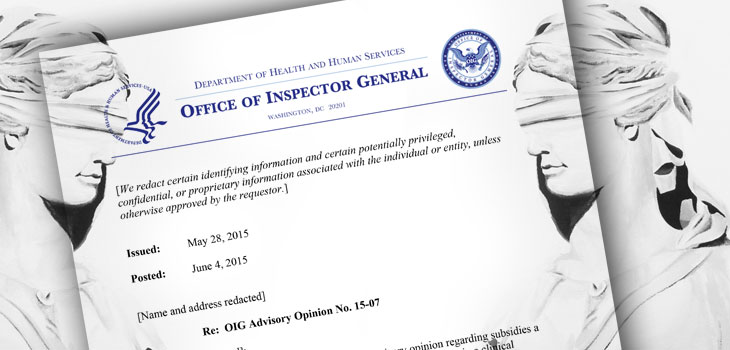
The OIG (Office of Inspector General) solved this problem in a June Advisory Opinion 15-07, (http://oig.hhs.gov/fraud/docs/advisoryopinions/2015/AdvOpn15-07.pdf) by approving manufacturer’s subsidies for products and services provided to clinical trial subjects.
“Minimal Risk”
According to the fdalawblog from Hyman, Phelps & McNamara, the OIG said that this arrangement presented minimal risk of fraud and abuse because the study was designed in consultation with CMS and the program was necessary to enable a properly designed study to be conducted. The OIG said this was “a reasonable means of achieving the Study’s goals because it both encourages necessary patient enrollment in the Study and allows for the true impact of the PILD using the System on patient health outcomes to be isolated and assessed.”
In other words, according to the blog, the subsidies were necessary both to keep financial considerations from inhibiting enrollment or causing drop-outs, and to maintain the blind.
The OIG also said that compensation paid to investigators was fair market value, thus not designed to induce physicians to use the system, and that overutilization would not be a problem because of the small number of subjects, the requirement that investigators follow the study protocol, and the oversight of an IRB (Institutional Review Board).
Author
React:
Discussion
This is a fascinating development. In my practice we've seen similar outcomes with the revised protocol. The key differentiator seems to be patient selection criteria. Has anyone else noticed the correlation with BMI thresholds?
Great point. I'd push back slightly on the conclusion, the sample size in the cited study is too small to draw population-level inferences. That said, the directional signal is compelling and worth a larger RCT.
We implemented a similar approach last year. Early results are promising but we're still gathering 12-month follow-up data. Happy to share our protocol if anyone is interested.
Join the conversation
Orthopedic professionals are discussing this. Sign in and upgrade to read every comment and add your voice.