
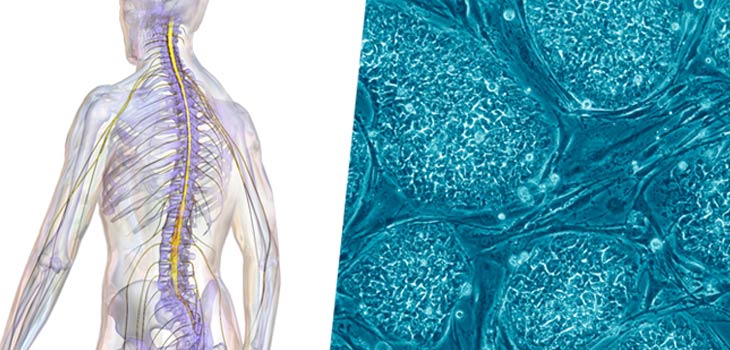
Researchers at Rush University Medical Center are delving into a new therapy using stem cells to treat spinal cord injuries that occur within the first 14 to 30 days of injury. There is only one of center in the U.S. that is studying this new treatment. According to the August 13, 2015 news release, “The therapy uses a population of cells derived from human embryonic stem cells containing progenitor cells that support nerve cells and can potentially make poorly functioning nerves function better.”
New Stem Cell Therapy for Spinal Cord Injuries
2 min read Premium comments
Secondary
“There are currently no therapies which successfully reverse the damage seen in the more than 12, 000 individuals who suffer a spinal cord injury each year in the United States alone, ” says Richard G. Fessler, M.D., professor of neurological surgery at Rush University Medical Center, in the August 13, 2015 news release. Dr. Fessler is principal investigator for the Phase 1 clinical trial involving AST-OPC1 (oligodendrocyte progenitor cells).
Enrollment is underway, and patients can expect a clinical trial that involves escalating doses of the special cells (AST-OPC1) for individuals with a complete cervical spinal cord injury. “These individuals have essentially lost all sensation and movement below their injury site with severe paralysis of the upper and lower limbs.”
“In the future, this treatment may be used for peripheral nerve injury or other conditions which affect the spinal cord, such as MS [multiple sclerosis] or ALS [amyotrophic lateral sclerosis or Lou Gehrig disease], ” said Dr. Fessler.
“For this therapy to work, the cord has to be in continuity and not severed. The study seeks male and female patients ages 18 to 65 who recently experienced a complete cervical spinal cord injury at the neck that resulted in tetraplegia, the partial or total paralysis of arms, legs and torso. Patients must be able to start screening within 25 days of their injury, and participate in an elective surgical procedure to inject AST-OPC1 14 to 30 days following injury. Participants also must be able to provide consent and commit to a long-term follow-up study.”
Asked about the importance of the 14-30 day timeframe, Dr. Fessler told OTW, “Abundant data from animal research has suggested that transplantation close to the time of injury yields superior results to delayed transplantation. The 14 to 30 day window enables the patient to be stabilized from his injury, and provides enough time for evaluation of tests for inclusion/exclusion in the study.”
“Two major events will occur over the next 6-12 months. First, each of the patients receiving a transplant will be followed closely to assess the results. Second, this study utilizes three cohorts of patients who will receive escalating doses of the stem cells. Over the next 6-12 months, therefore, as we move from one cohort to the next, the doses injected will be increased.”
React:
Discussion
This is a fascinating development. In my practice we've seen similar outcomes with the revised protocol. The key differentiator seems to be patient selection criteria. Has anyone else noticed the correlation with BMI thresholds?
Great point. I'd push back slightly on the conclusion, the sample size in the cited study is too small to draw population-level inferences. That said, the directional signal is compelling and worth a larger RCT.
We implemented a similar approach last year. Early results are promising but we're still gathering 12-month follow-up data. Happy to share our protocol if anyone is interested.
Join the conversation
Orthopedic professionals are discussing this. Sign in and upgrade to read every comment and add your voice.