
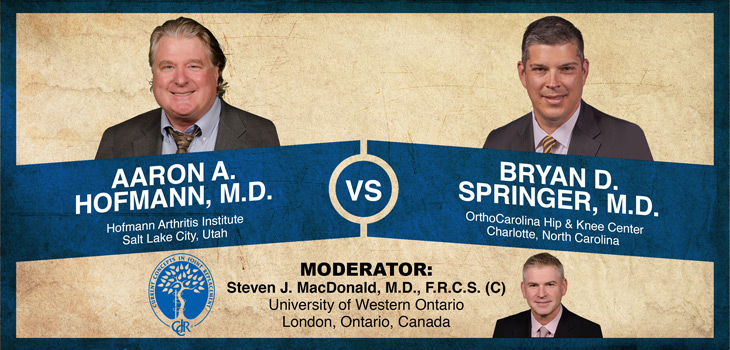
This week’s Orthopaedic Crossfire® debate was part of the 16th Annual Current Concepts in Joint Replacement® (CCJR) – Spring meeting, which took place in Las Vegas this past May. This week’s topic is “Measured Resection Trumps Gap Balancing in TKA.” For the proposition is Aaron A. Hofmann, M.D. from the Hofmann Arthritis Institute in Salt Lake City. Bryan D. Springer, M.D. with OrthoCarolina Hip & Knee Center in Charlotte is in opposition. Moderating is Steven J. MacDonald, M.D., F.R.C.S.(C) from the University of Western Ontario.
Measured Resection Trumps Gap Balancing in TKA
8 min read Premium comments
Great Debates
Dr. Hofmann: I’m going to be talking about measured resection being the simple way to do knee replacement. It’s the way I’ve done knee replacement for the last 30 years and I think it’s the least complicated way to do that, so let me just take you through how that’s done and the reasoning behind it.
There are lots of different names for this measured resection technique, the new name is kinematic, perhaps. That takes it to the extreme. Or the anatomic alignment, basically trying to get your knee balanced. A classic resection basically puts the tibia perpendicular to the long axis and then you spend the rest of the operation trying to balance around that. That’s my bias. Or you can take an anatomic philosophy and go parallel to the tibia and few degrees of varus and make your rectangular resection in extension and flexion. I think we all agree that’s our goal—to have a rectangular resection, in flexion, extension—and I do it by following the patient’s anatomy.
The difference, I think, with gap balancing, perhaps, and measured resection really comes from the tibial side. So if you make a perpendicular cut, you’re going to remove bone lateral and medial and that really means that you’re going to have to spend a lot more time balancing. If you take that same knee and cut parallel with two or three degrees of varus on the tibia, you’re balancing act is almost nothing.
Let me take you through a typical case. A medial sleeve is prepared…we have a mantra for this…medial meniscus, medial sleeve, medial osteophytes and we remove that soft tissue, but basically this is the only releasing we’re doing on a varus knee…just releasing that medial sleeve. On the lateral side, basically the lateral meniscus, the lateral sleeve, and lateral osteophytes are removed. If we look at the distal femur, you’re really taking an even resection on the medial and lateral side of the distal femur.
With this measured resection technique, we’re referencing the posterior condyles…on a varus knee you automatically externally rotate a little bit because there is a little cartilage missing medially…I draw in Whiteside’s line to make sure the rotation parallels that. And maybe lateralize the jig just a little bit, but basically following the patient’s anatomy within a degree.
We come to the tibia, there is a difference there. If we’re sacrificing the PCL [posterior cruciate ligament], we want to go just a little bit flatter. The newer designs actually have 3 degrees built into the polyethylene to compensate for the flexion gap being a little bigger than the extension gap—cutting the tibia a few degrees flatter solves that.
If we look from the proximal tibia, you can sight the block. There’s an even resection medial and lateral. Again, I’m only following the patient’s anatomy to within about 2 degrees of varus. I‘m not a whack-o that’s going 5 or 6 degrees of varus, but I am following the patient’s anatomy, so I’m looking to get an even resection medial and lateral.
Tibial sizing is done in standard ways, slightly lateralizing the tibial component and then basically a flatter tibial trial is something I’ve used for over 20 years. It’s like an articulating block spacer. You can check your flexion extension gap using flat spacers. Don’t forget about the patella that also should be a measured resection. I medialize it. I mark the medial sagittal ridge and I try to get back to that same thickness and simply remove the lateral facet of the patella.
I do take an intraoperative fluoroscopic x-ray on all patients and I document the interfaces at the time of surgery, not in the recovery room where basically you get 2 obliques.
My varus knees have slight varus on the short film, long axis looks like the mechanical axis is going through the medial compartment. It’s a perpendicular cut on the tibia, not a varus cut, for valgus legs, again using measured resection. And it’s a very efficient technique. Our average tourniquet time is 35 minutes. I think the proof of the pudding is basically the longevity of the components—98% survival.
Dr. Springer: I think our goals of total knee replacement are aligned regardless of the technique that we use. We’re trying to restore the mechanical axis, we’re trying to get symmetric ligament balance and a knee that moves through a range of motion, and there’s certainly debate and controversy about what surgical technique best achieves this. Where I think we differ, however, gap balancing takes a step-wise approach to the knee, balancing the extension gap and then the flexion gap. The main difference centers on how we rotate the femoral component. I think in my mind, using bony landmarks, can lead to inaccuracy in your ability to accurately find them at the time of surgery.
We take a step-wise approach to the knee. We cut the distal femur. We cut the proximal tibia. And then the knee is balanced in extension. Our goal then is to create a rectangle—so to go from asymmetry in extension, to a nice symmetric rectangular extension gap with appropriate tension on the ligaments.
What you have to realize, however, is that those releases that you do in extension do have an effect on the femoral component when you go into flexion. And depending on the amount of release that you have to do, a large medial release leads to instability on the medial side in flexion. You have to appropriately adjust your femoral rotation to accommodate for that and bony landmarks simply just don’t do that.
Then we balance the knee in flexion. This can be done in a variety of ways. You can use lamina spreaders. You can use a tensioner which allows you to set it at 90 degrees of flexion. Place tension on that knee in flexion. Match my balanced extension gap. Pin the block. And then be able to look at the 4-in-1 one cutting block in reference to my tibia as well as to the symmetry of the tension on the ligaments in flexion before I make my cuts and make any adjustments as needed.
Fixed bony landmarks, however, really suffer from the inability of the surgeon to accurately and reproducibly find them at the time of surgery. And I think this leads to substantial variation in the rotation and the sizing of the femoral component.
Let’s look at those bony landmarks in a little more detail. The upper transepicondylar axis—your ability to accurately find it within 3 degrees is only about 75% of the time. The AP axis, or Whiteside line, 32% range of error in the surgeon’s ability to accurately locate it. And 3 degrees off your posterior condyles, again inaccurate about 40%-45% of the time. And as it turns out, it make sense. Again, bony landmarks at best, 70% of the time are able to create a nice rectangular flexion gap.
What about gap balancing versus measured resection and its ability to accurately find those landmarks? Tom Fehring, 100 consecutive posterior stabilized knees comparing the two techniques. Rotational errors greater than 3 degrees were present in almost half when bony landmarks were used to determine femoral component rotation.
Doug Dennis and Ray Kim looked at femoral component liftoff in flexion using fluoroscopic studies… gap balancing had a significantly lower incidence of condylar liftoff greater than 1mm when those patients went into deep flexion. And more recently, Stephen Kreuzer looked at 31 total knees using navigation, looking at all the bony landmarks compared to a gap balance technique, looking at post-operative CT scans to assess the femoral component rotation, and there were significant differences in the lack of the ability of the bony landmarks to accurately balance the knee in flexion.
So in conclusion, I think our goals are the same and I think we’re aligned regardless of the technique that is used. But I think our ability to accurately find these landmarks is very limited and in my hands a gap balancing technique reliably reproduces a more balanced knee.
Moderator MacDonald: Thank you Brian, very nicely defended. I’ve not seen a clinical paper to show a difference. Not the biomechanics or the liftoff things, but actually clinically does it make a difference to the patient clinically. Aaron what do you think?
Dr. Hofmann: I’d say no. I think I’m really talking about how simple the operation can be and how you can make it transferrable to everybody in the world essentially. And to make a speedy, efficient operation. I think the fallacy in the papers that were being quoted by Dr. Springer…measured resection is not measured resection medial and lateral on the tibia. If you make a perpendicular cut on the tibia…and that’s what I do and that’s what the classic guys never do ‘cause you want a perpendicular axis on your tibia…but if you do that you’ve already started out with screwed up anatomy. I think if you follow the patient’s varus anatomy on the proximal tibia, if it’s there…and it’s there on a varus knee, it’s not there in a valgus knee…then the rest of the balance is easy. I’m sure I’m doing the same thing doing my flexion extension balancing…basically I’m using flat insert trials to do that, so it’s not that I’m not balancing the knee or fine tuning, or tweaking it, but I’m doing it a different way.
Dr. Springer: I think in reality there’s a lot more overlap here than what we think there is between these two techniques. We all want to look at the gap balancers over here and the measured resectors over here, and I think we tend to congregate in the middle a little bit more depending on how you look at the operation as a whole. For example, my distal femoral cut and my proximal tibia cut are essentially measured resection techniques. And my balancing in flexion is based on tension on the ligaments as opposed to bony landmarks. I think there is a big overlap there.
Moderator MacDonald: Well, gentlemen, thank you for a wonderful debate. Thank you very much.
Please visit www.CCJR.com to register for the 2015 CCJR Winter Meeting, December 9 – 12 in Orlando.
React:
Discussion
This is a fascinating development. In my practice we've seen similar outcomes with the revised protocol. The key differentiator seems to be patient selection criteria. Has anyone else noticed the correlation with BMI thresholds?
Great point. I'd push back slightly on the conclusion, the sample size in the cited study is too small to draw population-level inferences. That said, the directional signal is compelling and worth a larger RCT.
We implemented a similar approach last year. Early results are promising but we're still gathering 12-month follow-up data. Happy to share our protocol if anyone is interested.
Join the conversation
Orthopedic professionals are discussing this. Sign in and upgrade to read every comment and add your voice.