
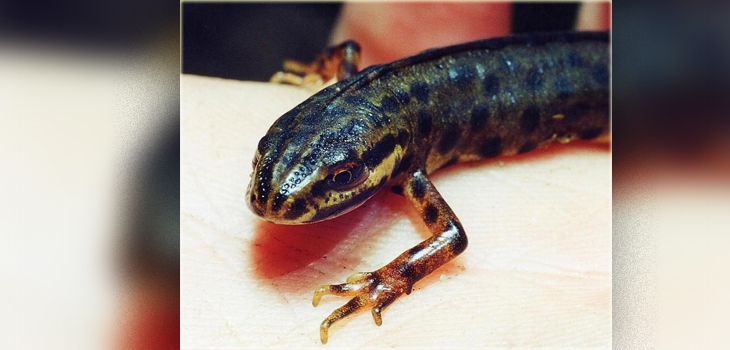
A newt is a common sort of lizard. But it can do something that we humans can not do. If a newt loses a limb, it can regenerate tissue to repair the loss.
Look to the Newt – Consider Its Ways and Be Wise
1 min read Premium comments
Secondary
According to David Garner York, writing for Health and Medicine, a newt’s cells respond to injury by aggregating and returning to a stem cell-like state. The process is known as de-differentiation. It causes the number of cells to increase so that the newt can generate the specialized cells needed to regenerate the damaged or lost tissue. How very clever of the newt.
Newts can regenerate lost tissue even when they sever a limb. Now scientists at the Arthritis Research UK Tissue Engineering Centre at the University of York, want to figure out how they do it. If successful they will use the knowledge to treat osteoarthritis.
Researchers at York are hoping to rejuvenate cells taken from older adults who have osteoarthritis ad use them to repair worn or damaged cartilage and reduce pain. The scientists cultivated these spheroid clusters of cells growing them in a 3D aggregation. Importantly, the scientists have succeeded in reverting the cells to an embryonic state.
“Using this technique we have shown that human cells can also be de-differentiated to an early embryonic stage. They are then capable of generating new tissues, ” says Paul Genever, Ph.D. of the University of York.
“The next stage is to find out more about the de-differentiation process so that we can find the right treatment to encourage tissue repair in the damaged joint.”
Author
React:
Discussion
This is a fascinating development. In my practice we've seen similar outcomes with the revised protocol. The key differentiator seems to be patient selection criteria. Has anyone else noticed the correlation with BMI thresholds?
Great point. I'd push back slightly on the conclusion, the sample size in the cited study is too small to draw population-level inferences. That said, the directional signal is compelling and worth a larger RCT.
We implemented a similar approach last year. Early results are promising but we're still gathering 12-month follow-up data. Happy to share our protocol if anyone is interested.
Join the conversation
Orthopedic professionals are discussing this. Sign in and upgrade to read every comment and add your voice.