
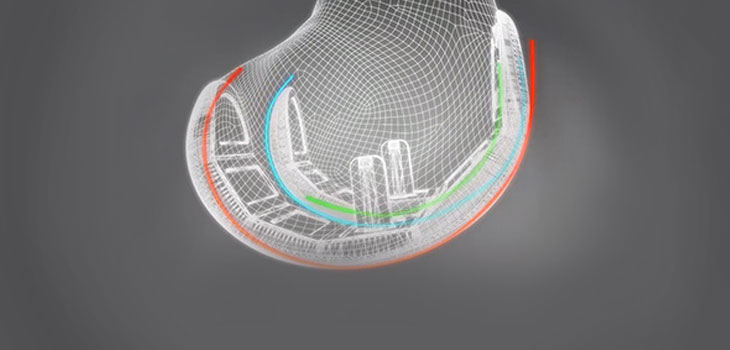
Six new clinical studies are confirming that ConforMIS, Inc. is having a good year. One study, an ongoing, blinded, U.S. multicenter study, found that patients with customized ConforMIS iTotal CR knee replacements were more likely to have an excellent or good objective Knee Society Score (KSS). These patients walked statistically significantly faster than patients with standard knee replacements.
ConforMIS iTotal CR Knee Scores in Research Arena
2 min read Premium comments
Secondary
According to the August 3, 2015 news release, “Patients with iTotal CR knee replacements were 1.7 times more likely to achieve an excellent or good objective KSS, whereas patients with off-the-shelf knee replacements were 2.6 times more likely to achieve a poor objective KSS.”
Robert Tait, M.D. is chief of staff at St. Rose Dominican Hospital Siena in Henderson, Nevada, and lead investigator on this clinical study. Dr. Tait told OTW, “We found that the iTotal knees outperformed the off-the-shelf knees in every metric we measured. In addition, the subjective high demand activity the patients select as most important to them was distance walking, and the iTotals showed a statistically significant improvement in this activity.”
Another investigation—a prospective multicenter study of 252 patients with iTotal CR knee replacements—found high patient reported outcome scores, high range of motion, short hospital stay and an “excellent” safety profile.
“In two other studies, investigators used real-time x-ray imaging with mobile fluoroscopy to study the movement, or kinematics, of the knee during deep knee bend and chair rise in patients with iTotal CR knee replacements compared to patients with off-the-shelf knee replacements. The investigators observed knee motion that was more consistent with normal knee movement in patients with iTotal CR knee replacements compared to patients with off-the-shelf knee replacements. During a deep knee bend, patients with iTotal CR knee replacements achieved greater weight bearing flexion compared to patients with off-the-shelf knee replacements. In the second study, during a deep knee bend, 35% of patients with off-the-shelf knee replacements experienced implant lift-off in early flexion, whereas none (0%) of the patients with iTotal CR knee replacements experienced implant lift-off in early flexion.”
The remaining studies relate to customized ConforMIS iUni and iDuo partial knee replacements. In a prospective multicenter study, 89% of the 118 enrolled patients stated that the movement of their knee felt natural. In a single-center study of 31 patients with ConforMIS iDuo customized implants, investigators found that a majority of patients rated their result as good or excellent, and 97% of patients reported that they would hypothetically undergo the same surgery again.
React:
Discussion
This is a fascinating development. In my practice we've seen similar outcomes with the revised protocol. The key differentiator seems to be patient selection criteria. Has anyone else noticed the correlation with BMI thresholds?
Great point. I'd push back slightly on the conclusion, the sample size in the cited study is too small to draw population-level inferences. That said, the directional signal is compelling and worth a larger RCT.
We implemented a similar approach last year. Early results are promising but we're still gathering 12-month follow-up data. Happy to share our protocol if anyone is interested.
Join the conversation
Orthopedic professionals are discussing this. Sign in and upgrade to read every comment and add your voice.