
Shining a light on healing…Ali Khademhosseini, Ph.D., and Nasim Annabi, Ph.D. of the Biomedical Engineering Division of Brigham and Women’s Hospital (BWH) have led a team that has created a new protein-based gel for healing. When you expose the gel to light, say the researchers, it behaves like elastic tissue.
Protein-Based Gel Advances Wound Healing
2 min read Premium comments
Secondary
“We are very interested in engineering strong, elastic materials from proteins because so many of the tissues within the human body are elastic. If we want to use biomaterials to regenerate those tissues, we need elasticity and flexibility, ” said Dr. Annabi, a co-senior author of the study, in the July 2, 2015 news release. “Our hydrogel is very flexible, made from a biocompatible polypeptide and can be activated using light.”
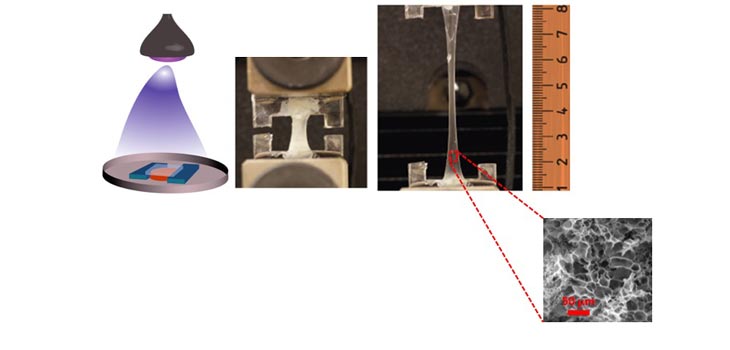
As indicated in the news release, “The new material, known as a photocrosslinkable elastin-like polypeptide-based (ELP) hydrogel, offers several benefits. This elastic hydrogel is formed by using a light-activated polypeptide. When exposed to light, strong bonds form between the molecules of the gel, providing mechanical stability without the need for any chemical modifiers to be added to the material. The team reports that ELP hydrogel can be digested overtime by naturally-occurring enzymes and does not appear to have toxic effects when tested with living cells in the lab. The team also found that they could control how much the material swelled as well its strength, finding that the ELP hydrogel could withstand more stretching than experienced by arterial tissue in the body. The researchers found that it was possible to combine the gel with silica nanoparticles—microscopic particles previously found to stop bleeding—to develop an even more powerful barrier to promote wound healing.”
“Our hydrogel has many applications: it could be used as a scaffold to grow cells or it can be incorporated with cells in a dish and then injected to stimulate tissue growth, ” said Dr. Annabi. “In addition, the material can be used as a sealant, sticking to the tissue at the site of injury and creating a barrier over a wound.”
Dr. Khademhosseini told OTW, “For many regenerative engineering applications, it is important to have biomaterials with desired mechanical properties that induce tissue regeneration and healing. These gels offer a potentially useful material particularly for tissues that require vascularization and soft tissue regeneration/mineralization.”
“We aim to move forward by pushing specific medical applications that require tissue regeneration combined with specific mechanical features.”
The BWH team worked with the laboratory of Bradley Olsen, Ph.D. at the Massachusetts Institute of Technology. Also contributing to this work were: Yi-Nan Zhang, Reginald K. Avery, Queralt Vallmajo-Martin, Alexander Assmann, Andrea Vegh and Adnan Memic.
React:
Discussion
This is a fascinating development. In my practice we've seen similar outcomes with the revised protocol. The key differentiator seems to be patient selection criteria. Has anyone else noticed the correlation with BMI thresholds?
Great point. I'd push back slightly on the conclusion, the sample size in the cited study is too small to draw population-level inferences. That said, the directional signal is compelling and worth a larger RCT.
We implemented a similar approach last year. Early results are promising but we're still gathering 12-month follow-up data. Happy to share our protocol if anyone is interested.
Join the conversation
Orthopedic professionals are discussing this. Sign in and upgrade to read every comment and add your voice.